What are you working on?
Tell it once and every capacity, clearance, torque figure and jetting table below resolves to your machine — and stays with it. The book is open either way; you can set this any time under My Bike.
What do you need?
Start hereHow this book works+
The Book
Compiled from factory literature, service bulletins and five decades
of shop practice. Every value traceable; every conflict printed.
Set in Cormorant Garamond, Lora & IBM Plex Mono.
Every value traceable to a named source.
First Edition · MMXXVI
Identity
Pick your bike and the numbers below resolve to it — capacities, clearances, timing marks, tyre pressures and a torque sheet. In the chapters, rows that apply to your bike get marked; nothing is ever hidden, because a mis-tagged row must never be able to deprive you of a torque figure.
What you’re working on
Your bike’s numbers
Torque sheet
gold = ft-lb · grey = N·m · under the name: wrench · thread, where compiled — blank means not yet sourced, never “none”
The book, filtered to your bike
Every row the guide can confirm for your machine, chapter by chapter. Open one below, or tap open in full to read the whole chapter.
Due & overdue
Unit converter
ft-lb · Nm · in-lbYour data
local to this deviceBack this up. Browsers can and do clear site storage without warning, and a phone-only service history is a service history you will lose. Export after every entry that matters.
- Search the thing, not the question. Type flywheel, not “what is the flywheel torque”. Every row is matched on its own words.
- Part names beat descriptions. rocker, needle jet, thrust washer, swingarm.
- Numbers work. Search a part number (13 72 1 254 654), a size (0.10), or a jet (160).
- So do symptoms. ping, rich, undercharge, grabby, rub.
- Short beats long. One or two words. shim finds more than transmission shimming procedure.
- Brands are indexed. Siebenrock, Motogadget, EnDuraLast, Cerakote, Bing.
ORIGINCHAPTER IA History of the Airhead
▶
It began, as good engineering often does, with a complaint. In 1922 the Treaty of Versailles had forbidden Germany from building aircraft engines, and BMW — a company that until then had made almost nothing else — was reduced to air brakes, farm machinery and office furniture. When Franz Josef Popp asked his design director to assess the Helios, a motorcycle the firm had inherited through merger, Max Friz reported back that the best thing to do with it was throw it in the nearest lake. Its engine sat with the crankshaft fore and aft, and the rear cylinder cooked itself in the shadow of the front one.
Friz's answer was not to improve the cooling. It was to turn the engine sideways so that both cylinders stood out in the airstream, where nothing could hide from the wind, and to run the drive straight back through a shaft rather than a chain. The R32 that resulted in 1923 made 8.5 horsepower from 494 cc and would do about sixty miles an hour. Only three thousand or so were built. But the shape of it — a flat twin with its heads in the breeze and a driveshaft down the right side — is still the shape of a BMW boxer a century later. Very few design decisions survive their designer. This one survived the century.
The engine in your workshop is a direct descendant, and it arrived with a change of address. Through the sixties, car production in Munich swelled until the motorcycles had to go somewhere else; in 1969 BMW moved the whole operation to Berlin-Spandau, into a plant that had once built radial aircraft engines for Siemens. What came out of it that year was the /5 — the R50/5, R60/5 and R75/5 — an entirely new machine built on a modular principle from the suspension to the flat twin itself. It sold. Production ran five-fold in three years, and by the time the /5 ended in July 1973 nearly sixty-nine thousand had left the line.
Then the decade the platform is remembered for. In 1973 the engine grew for the first time and gave us the R90/6 and the R90S, that smoked-orange half-faired thing that made touring bikes look fast. The /6 of 1974 brought a front disc and the five-speed box. In 1976 the R100RS arrived as the first production motorcycle in the world to wear a full frame-mounted fairing, developed in a wind tunnel, and the R45 and R65 filled in beneath it. Annual production passed thirty thousand for the first time in 1977. This is the high-water mark of the airhead: the range at its widest, the engineering at its most confident.
And in 1980, almost as an afterthought, the machine that outlived all of them. The R80 G/S was the world's first production motorcycle with a single-sided swingarm, and on paper it was absurd — a 797 cc shaft-drive twin weighing four hundred pounds, entered into a sport where everyone else rode light singles. In 1981 Hubert Auriol took it to overall victory in the Paris–Dakar, the first ever for a multi-cylinder motorcycle. He won again in 1983; Gaston Rahier, all five foot four of him, won in 1984 and 1985. The photographs of that enormous tank and those cylinder heads jutting into the Sahara did more for the boxer than any brochure ever printed, and every adventure bike sold since owes it a debt.
The end came quietly and from inside the family. The water-cooled K100 landed in 1983, and in 1993 — seventy years after the R32 — the R1100RS introduced a boxer with oil cooling and four valves per head. Only then did anyone need the word airhead: it is a retronym, coined backwards to describe what had just been superseded. The last of them, the R100R and its Mystik variant, trickled out of Spandau into 1996. Then the line that Max Friz drew in December 1922 finally stopped moving.
Which brings us to the bench. What you have is not a vintage motorcycle in the fragile sense — it is a mature industrial design that was refined for seventy years and then discontinued while it was still good. The tolerances in this book are wide because the engine was built to be serviced by hand, at the roadside, by someone who owned a feeler gauge and a decent memory. Nothing on it is hidden. Nothing on it requires a laptop. It will tell you what is wrong if you know how to ask, and everything after this chapter is a way of asking.
| Year | Event | Why it matters | Notes | ||
|---|---|---|---|---|---|
| 1923 | R32 | 494 cc · 8.5 hp @ 3200 rpm | the layout is born | Max Friz turns the engine transverse so both cylinders sit in the airstream, and adds shaft drive. 3,090 built through 1926. Every boxer since is this drawing. | |
| 1969 | /5 — R50/5, R60/5, R75/5 | Munich → Berlin-Spandau | the modern airhead begins | All-new modular design in a former Siemens aero-engine plant. 68,956 built to July 1973. | |
| 1973 | R90/6 & R90S | first displacement increase | the range grows up | The R90S gave the boxer a sporting reputation it had not had before. | |
| 1974 | /6 series | front disc · 5-speed | brakes and gears | Early disc used a hybrid cable-to-master-cylinder linkage. Rectangular tank dropped. | |
| 1976 | R100RS · /7 series | 980 cc | the platform peaks | First volume-production motorcycle in the world with a full frame-mounted fairing. R100, R100S, R100RS, R75/7, R60/7. | |
| 1977 | R45 & R65 added | 30,000+ units/year | widest range | Annual production passes thirty thousand for the first time. | |
| autumn 1980 | the great changeover | new crankcases · Galnikal bores · electronic ignition from '81 | the parts watershed | The single most important date for ordering parts. Ask “before or after 9/80”, never the model year — see Spec Boundaries. | |
| 1980 | R80 G/S | 797 cc · Monolever | the ancestor of every adventure bike | World's first production motorcycle with a single-sided swingarm. | |
| 1981–85 | Paris–Dakar | Auriol '81 & '83 · Rahier '84 & '85 | proof | Auriol's 1981 win was the first for a multi-cylinder machine in the event. | |
| 1983 | K100 | water-cooled four | the succession starts | The airhead is no longer the future of the company. | |
| 1985–87 | monolever boxers | R80RT '85 · R100RT '87 | late refinement | Single-sided swingarm reaches the road bikes. | |
| 1993 | R1100RS — the oilhead | 1085 cc · 4 valves · oil-cooled | the word is invented | Seventy years after the R32. Only now does anyone say “airhead” — a retronym for what came before. | |
| 1995–96 | R100R & R100R Mystik | the last ones | end of the line | Seventy-three years after Friz finished his drawings. |
Elspeth Beard and the extra base gasket
Twenty-three years old, a 1974 R60/6 with 45,000 miles already on it, and a letter from BMW politely declining to help.
She had asked around for sponsorship before she left, the way you were supposed to. Most of the manufacturers and magazines did not reply at all. BMW in Munich did — a courteous letter explaining that they would not be supporting her ride around the world. She kept it. It is reproduced in her book, which is a quieter form of revenge than most people manage.
What she did instead is the part that belongs in a workshop manual. She bought a Haynes manual and stripped the engine down to understand it. She replaced every cable, fitted a new battery, changed all the oils, put new tyres on a motorcycle that had already covered forty-five thousand miles. And then she took the cylinder heads off and fitted an extra base gasket, deliberately lowering the compression, because she had worked out that the fuel between London and Sydney was not going to resemble the fuel in Surrey.
That is a decision from the Finishes and Upgrades chapters of this book, taken in a garage in 1982, by someone who had reasoned it out from first principles rather than read it anywhere.
She rode out in October 1982 with no sponsors, no GPS, no mobile telephone and just enough money to cross the Atlantic. Thirty-five thousand miles followed: north into Canada, south to Mexico, the bike shipped to New Zealand and then Australia, where she crashed it. Hepatitis caught up with her in Iran. She forged permits in India. She came home to London in November 1984, one of the first British women to have ridden a motorcycle around the world alone, and then quietly went back to finishing her architecture degree.
In 1988 she bought a derelict hundred-and-thirty-foot Victorian water tower and spent seven years turning it into a house, which went on to win five architectural awards. The R60/6 is still in the garage underneath it — restored, not on a plinth, parked between a 1973 R75/5 and the R80 GS Basic she still rides most days.
Helge Pedersen, Olga, and twenty days in the Darién
A quarter of a million miles, seventy-seven countries, and one stretch of jungle that took three weeks to cross.
He left Kristiansand in 1982 on an R80 G/S with loose plans and a tight budget, which is how most of these stories start and not how most of them continue. The trip lasted ten years. By the end the motorcycle — he called it Olga — had covered more than two hundred and fifty thousand miles through seventy-seven countries, which is roughly ten times around the earth on an air-cooled twin designed in the 1960s.
Ask him which part mattered most and the answer is not a country. It is sixty-six miles: the Darién Gap, the roadless swamp and forest between Colombia and Panama where the Pan-American Highway simply stops. There is no route through it. There was no route through it then either. With the help of a German backpacker he had picked up along the way, Pedersen spent twenty days wrestling a four-hundred-pound shaft-drive BMW across rivers and through jungle that had no interest in either of them.
Olga now sits in the BMW Museum in Munich — which is a fair resting place for a motorcycle that went a quarter of a million miles on the strength of the numbers in this book.
He has been leading rides ever since, out of Seattle, and has taken groups to Tierra del Fuego more times than most people ride to the next state.
The desert years
Everyone knew the Dakar belonged to light singles. Nobody had told BMW.
In 1981 Hubert Auriol took an R80 G/S to overall victory in the Paris–Dakar, the first time a multi-cylinder motorcycle had ever won the event. On paper the thing made no sense at all: a shaft-driven boxer weighing four hundred pounds, entered against nimble singles, in a rally that was then closer to an expedition than a sport — compass and roadbook, and terrain that punished machine and rider equally.
He did it again in 1983. Then Gaston Rahier, who stood five foot four and by most accounts could not get both feet down, won it in 1984 and again in 1985. The photographs from those years — that enormous tank, those cylinder heads jutting out into the Sahara — did more for the boxer than any advertisement BMW ever paid for, and every adventure motorcycle sold since owes them something.
BUYINGCHAPTER IIWhich One to Buy
▶
Twenty-five years of production, and the differences between one end and the other are larger than newcomers expect. A 1972 /5 and a 1993 R100R share an engine layout and very little else — different brakes, different suspension, different ignition, different character.
What follows is the shape of the range, the years the long-standing names in this hobby single out, and the specific faults worth knowing before you hand over money. One caution before any of it: as one MOA member put it, there are no trouble-free airhead years. Every model has its warts — the question is only which ones you are willing to live with.
Nothing here is scraped or copied. Each button opens that marketplace's own search, already filtered to your area and the machine you want — the same way the fiche finder deep-links the parts diagrams. Facebook and Craigslist search by city; the rest are national, and eBay can take a ZIP for a radius.
Before you drive to see one, read Before you hand over the money at the foot of this chapter and take the book — the eras table and the faults-by-name are exactly what to walk round the bike with. Sellers rarely know which September their bike was built in; tells you how to find out from the frame number.
| Source | Their picks | Avoid | Notes | ||
|---|---|---|---|---|---|
| Oak Okleshen | 1976, 1979, 1980, 1983, 1984, and 1990-on | the good years | 1970 · 1974 · 1981 | One of the most respected names in airhead work. Note that 1981 appears on his avoid list even though it is the first year of the improved engine — first-year-of-a-redesign caution, not a verdict on the design. | |
| Tom Cutter | 1976 R75/6, then 1979 R100S or R100T, then 1977 R100RS, then 1994 R100 Mystic | in that order of preference | — | A working specialist’s order of preference, which is a different question from what is most collectible. | |
| Common forum view | an ’85-or-later R80 | valve, brake and other issues addressed by then | monolever R65 (late ’85 on) | The R80 is regularly called the smoothest airhead — less stressed than the 1000, and the sweeter engine of the two. The twin-shock R65s are liked as compact town bikes; the later monolever R65 much less so. |
STARTCHAPTER IIIThe Short Course
▶
Everything else in this book answers a question you already know to ask. This chapter is for the questions you do not — the order to do things in, the habits that save a weekend, and the mistakes that are common enough to have names.
None of it is difficult. Airheads were built to be maintained by their owners, with hand tools, at the roadside if necessary. What catches people is sequence: the right job done in the wrong order wastes a fortnight and teaches you nothing.
TOOLSCHAPTER IVThe Toolbox
▶
Most of an airhead comes apart with ordinary metric tools and patience. What stops the job is never the socket set — it is the one purpose-made thing you do not own, discovered at the point where the engine is already in pieces.
This chapter separates the tools you need before you start from the specials you can buy when the job demands them. Prices drift; treat them as order-of-magnitude. The one rule worth stating plainly: buy the tool before you improvise, because on a forty-year-old casting the improvised version usually costs more than the tool.
CCycle Works — made many of the airhead tools in circulation. Worth knowing that their range has narrowed over the years, so some tools you will see referenced in older write-ups are no longer sold new. Second-hand ones hold value.
BBeemer Boneyard — clutch alignment tools and general airhead stock, with used parts alongside.
GGeneric discount tools — presses, bearing separator kits and basic pullers do not need to be specialist. Save the money for the tools that touch a part you cannot replace.
SSnowbum — Tools — bmwmotorcycletech.info/tools.htm, exhaustive, opinionated, and includes factory part numbers for the original BMW kit tools.
MMOA — Airhead special tools list — forums.bmwmoa.org, the thread where owners compare what they actually use.
SCHEDULECHAPTER VMaintenance Schedule
▶
There is no single factory schedule that spans 1969 to 1995. BMW's published intervals changed with the models, and the only one reproduced verbatim and verifiable today is the /5 booklet — a two-tier 3,000-mile minor and 6,000-mile major service. Everything after that has to be assembled from the factory literature that survives, the independent authorities, and five decades of what actually went wrong.
So this chapter gives you both columns. Where BMW and Robert Fleischer disagree — and they disagree often — you get both figures and the reason. Where the factory schedule is simply silent on something that destroys airheads, that is called out, because the most consequential item on the whole ladder does not appear in any factory service booklet at all: the transmission input splines.
Two structural warnings. First, several of the items below are governed by time, not mileage — brake fluid, fork oil, fuel line, tyres, battery — and those are the ones a low-mileage bike misses entirely. Second, every interval here assumes moderate use. Sidecar, trailer, heat, dust or a diet of short trips moves most of them earlier, and the ladder says where.
| Item | Interval | Factory | Applies | Why it is on the list | |
|---|---|---|---|---|---|
| Engine oil level | every ride | every ride | All | Airheads use oil and leak oil. Check on the centre stand. | |
| Tyre pressures | every ride | every ride | All | Cold. See the pressures table below — the 1970s placard figures are too low for modern tyres. | |
| Cables — look-see for fraying | every ride | — | All | A broken strand today is a stranding next month. | |
| Lamps — operation and sagging filaments | every ride | — | All | Airhead vibration kills filaments; a sagging one is about to go. | |
| All four oil levels | pre-tour | — | All | Engine, transmission, driveshaft housing, rear drive. Paralever has no shaft-housing oil. | |
| Cable barrel ends — lubricate | pre-tour, and after every wash | — | All | Moly-containing oil. Note: barrel ends only — see the cable-lubrication conflict below. | |
| Clutch adjustment — check the transmission nut is not loose | pre-tour | — | All | It backs off, and you find out at a junction. | |
| Battery load test | every 6 months | — | All | Voltage alone tells you almost nothing. Load test. |
| Item | Recommended | Factory (/5) | Applies | Notes | |
|---|---|---|---|---|---|
| Engine oil | 5,000 mi or 1 year | 3,000 mi / 6 mo | winter: 1,500 mi / 3 mo | All | Whichever comes first — the year is not optional. Short-trip commuting: ~3,500 mi. The factory figure is shorter here; modern oil is why the recommendation moved out. |
| Oil filter | every other oil change | every oil change | All | Genuine BMW filters, new O-rings each time. The 44 × 4 mm high-pressure O-ring 11-42-1-337-098 is never reused. | |
| Valve clearances (incl. rocker end float) | 5,000 mi or yearly | 6,000 mi | 1981–84: check far more often | All | Airhead exhaust valves recede and clearances close up. A tight exhaust valve is the documented burnt-valve mechanism. After a rebuild: ~100 mi, ~600 mi, ~2,000 mi, then settle into the 5,000 rhythm. |
| Points — gap, cam grease, timing, ATU | 5,000 mi | inspect 3,000 & 6,000 | '70–'80 | Nothing to do on '81+ Hall systems. | |
| Carb synchronisation | 5,000 mi | — | All | After a minimum 10-mile ride — cold sync is meaningless. | |
| Bing enrichener — 4 screws for tightness & gasket | 5,000 mi | — | Bing CV | Loose = a lean-out and, occasionally, a fire. | |
| Speedo cable boot, right rear of gearbox | 5,000 mi | — | All | Water gets in here and the gearbox oil comes out looking like creamed coffee. Seal with black RTV; do not use zip ties. | |
| Nut & bolt check | 5,000 mi | — | All | ||
| Air filter — clean | 10,000 mi | clean at 3,000 & 6,000 | All | Replace on condition, ~30,000 mi typical. Stock filters often go well beyond that in clean conditions. | |
| Transmission, driveshaft housing & rear drive oil | 10,000 mi — factory | and at least once a year | heavy load, heat or dust: 5,000 | All | BMW-TD77 All three change at every Inspection — 15,000 km (10,000 miles) — with the schedule footnote “at least once a year”. Sidecar, trailer or hot-and-dusty use pulls this in to 5,000. The 15,000-mile extension for full synthetic is this guide's position, not BMW's — BMW's schedule makes no allowance for oil type. |
| Transmission input splines — clean & re-lube | 15,000 mi | not in the factory schedule | do not exceed 18,000 | All to ~1993/94 | The single most consequential airhead interval, and BMW never published it. Roughly double for later nickel-plated shafts — though that plating date is itself disputed. See the Splines chapter. |
| Swingarm bearings — service | 15–20,000 mi | — | All | Re-grease through the pivot adjusters roughly twice a year in between. | |
| Alternator brushes — visual check | 15–20,000 mi | — | All | Confirm the snail springs are not bottoming. | |
| U-joint bolts at the transmission flange | 15–20,000 mi, and yearly | — | All | Check at 26 ±2 ft-lb without loosening first. Push the accordion boot back. These backing out has torn the rear off a gearbox. | |
| Spark plugs — replace | 15–30,000 mi | inspect 3,000 | All | 30,000 is realistic on unleaded. | |
| Clutch lever bush, throwout parts, bar levers, enrichener control, rear brake lever — clean & lube | 15–20,000 mi | — | All | Check the nylon bushing at the bar lever for wear while you are there. | |
| Fork oil | 10,000 mi — factory | and at least once a year | factory interval, not a 2-year cap | /7 documented; treat as All | BMW-TD77 Corrected from the 2-year figure this guide used to print. BMW's /7 schedule changes the fork oil at every Inspection — 15,000 km (10,000 miles) — and the schedule's own footnote adds “at least once a year”. That is more frequent than the two-year cap widely quoted in the community, including by earlier revisions of this guide. Amounts are strongly model-dependent — see Capacities & Fluids. |
| Steering head bearings — clean, grease, adjust | 30,000 mi | — | All | Sources split between 30,000 mi and 50,000 mi / 4 years. Cleaning and regreasing often cures the "notchy" feel that seems to demand new bearings. | |
| Carburettor floats & float needles | 30,000 mi | — | stock original floats | Always replace the needles at the same time. | |
| Carburettor slide needles | 30,000 mi | — | aluminium type | ||
| Carb diaphragms — replace | 60,000 mi | — | Bing CV | During the carb overhaul. Perished diaphragms are a top-three airhead running complaint. | |
| Front forks — overhaul | 60,000 mi | — | All | Usually mostly cleaning and new bumpers. | |
| All control cables — replace | 60,000 mi | — | All | Keep the old ones on the bike as emergency spares if still sound. | |
| Timing chain, guides, tensioner, oil relief spring | 80–100,000 mi | — | All | Possibly one or both sprockets. Fit the latest-version tensioner and guide. | |
| Compression / leak-down test | 80–100,000 mi | — | All | Leads to the valve job, guides, decoke and rings decision. Thresholds are model-specific — see General & Tune. | |
| Starter motor — overhaul | 80–100,000 mi | — | All | ||
| Transmission — overhaul | 80–100,000 mi | — | All | ||
| Oil pan, screen and pickup — clean | once, at any oil change | — | All | A do-it-once item. Blue medium-strength threadlocker on the internal bolts. |
| Item | Interval | Limit | Applies | Notes | |
|---|---|---|---|---|---|
| Brake fluid | yearly — factory | no BMW schedule permits 3 years | time, not mileage | All disc models | DOT 4 (DOT 3 acceptable). Never DOT 5 silicone in a BMW. Hygroscopic — the boiling point falls and the internals corrode whether you ride or not. Bleed the rear caliper unbolted with the bleeder port vertical. Annual is BMW's own recommendation. BMW-TD77 The /7 owner literature says it in bold: “We also recommend that you change the brake fluid once each year.” Note where it sits — the maintenance-schedule table itself lists only check brake fluid level; the annual change appears in the Service text alongside the advice to have two Inspections a year. The 24- and 36-month figures circulating in the community are shop and owner practice, not a BMW allowance. BMW-WSM7 §34 Fluid spec by sheet: 12.77 prints DOT 3; the ’79 and 1981 sheets print ATE “DOT 4 SL”. DOT 4 has been the factory call since 1979 — not a modern retrofit. |
| Fork oil | yearly | or 10,000 mi | BMW factory interval | All | BMW-TD77 Annual is the factory footnote, not a conservative add-on. Replace sooner if dark. |
| Engine oil | 1 year | 5,000 mi | factory: 6 months | All | Acid and condensation do not care about mileage. |
| Fuel lines | ~2 years | — | inspect every ride | All | Ethanol shortens the life of the old rubber hose sharply. Nitrile deteriorates in alcohol; EPDM does not stand up to petrol long-term. BMW black DIN hose 13-11-1-338-115 (6 mm ID × 11 mm OD); Tygon F-4040A is widely reported as the best-lasting alternative. Hose clamps on the fuel lines are a pre-purchase red flag. |
| Tyres — by age | 5–6 years in service | this guide: buy none over 3 years old | maker guidance varies | All | Tyre makers do not agree on a single age limit and several publish none at all — treat 5–6 years as common industry guidance rather than a rule, and check what your tyre maker actually says. “Nothing over three years old at purchase” is this guide's conservative buying preference, not a manufacturer requirement. DOT code is a 4-digit week/year on the sidewall — "1016" is week 10 of 2016. Age and tread depth are separate tests. |
| Battery | 4–7 years | load test every 6 months | All | Replace on tested performance, not on age alone. Quality flooded: 5 years, declining toward 8. AGM: 5–8, sometimes longer. | |
| Rubber brake hoses & grommets | 15–20 years | — | test by feel under hard lever pressure | All disc models | No bulging. Some straightening under pressure is normal. Storage conditions dominate — sources are more permissive than 15 years for well-kept originals. |
| Exhaust port finned nuts — anti-seize | every 1–2 years | not in the factory schedule | yearly if lots of short trips | All | Nickel anti-seize on the threads, never oil — oil carbons up and seizes them. Brass-brush first. If a nut suddenly starts to seize on the way out, stop. The alternative is a destroyed cylinder head. |
| Ignition module heat-sink grease | 2 years | 3 years maximum | '81+ electronic | Dow Corning Type 340 or equivalent white zinc-based compound. Riveted modules are not serviceable. The module cooks itself without it. | |
| Electrical connections — inspect | yearly (all accessible) | every 3 years minimum | All | Half the charging-system faults on the forums are a connection, not a component. | |
| Rear shocks | 5–7 years | — | All | Single-source figure — treat as guidance, not spec. | |
| Swingarm bearings — re-grease | ~twice a year | — | more if you ride deep water | All | Through the allen pivot adjusters. Full clean and inspect every few years. |
| Item | When | Applies | Notes | ||
|---|---|---|---|---|---|
| New tube | every tyre change | front and rear | tube-type wheels | Always. All spoked airhead wheels are tube-type unless cross-spoked. | |
| Wheel bearings — clean, grease, check preload | every tyre change | preload at least every 2nd | pre-1985 only | Pre-1985 are greasable tapered rollers (30203-A: 17 mm bore × 40 mm OD × 13.25 mm overall width — the 12 mm often quoted is the inner-ring/cone width, not the assembled bearing). 1985+ are sealed 6005 balls — not serviceable, replace only. R65LS went to balls early. New seals each service. Never moly grease in wheel bearings — it clumps and flakes. | |
| Wheel bearing preload | 20–35 in-oz | factory 21–42 in-oz | pre-1985 | String on a 1.5 in spacer plus a spring scale. Low end preferred. | |
| Rear wheel splines — inspect, clean, re-grease | every tyre change | check the cup rivets first | Twin-shock | Brush moly grease from the outboard end inward so grit is not pushed into the large drive seal. Monolever and Paralever have no rear wheel splines. | |
| Rear wheel play | every tyre change | shop check ≈0.020 in at the rim | not a factory limit | Monolever · Paralever | This is the large cardan bearing, not splines. 0.020 in is a workshop diagnostic figure, not a BMW specification — the late factory manuals simply instruct you to correct the bearing when play can be felt at all. Use 0.020 in as the point at which wear is clearly accelerating, and perceptible play as the point at which to act. |
| Brake pads / linings, and the two caliper pins | every tyre change | dry-lube the pins | All | Check for dragging while the wheel is out. Never hang a caliper unsupported by its hose. | |
| Rear brake cam O-rings (drum) | every 2nd tyre change | grease the shaft every change | drum rear, to 1984 | From 1985 the rod runs in a tube with no O-rings — still grease the shaft. | |
| Swingarm — adjust and grease | every tyre change | — | All | Through the pivot adjusters. See the Splines chapter for the set–back-off–re-set procedure. |
| Condition | Front | Rear | Applies | Notes | |
|---|---|---|---|---|---|
| BMW factory — solo | 1.9 bar F / 2.0 bar R | ≈28 / 29 psi | historical | /7-era · 12.77 sheet | BMW-RA382 Factory wheel-load sheet: the permitted loads are rated at these pressures, cold. Printed here because it is the factory figure, not because it is what to run — a modern carcass on the bike outranks a 1977 table. |
| BMW factory — two-up or laden | 2.0 bar F / 2.25 bar R | ≈29 / 33 psi | historical | /7-era · 12.77 sheet | BMW-RA382 Same sheet, with a passenger. Above a sustained 160 km/h both sheets add ~0.2 bar per wheel. Note the booklet's own misprint: the US Technical Data booklet prints the rear solo figure as “2.5 atm (29 psi)”, and 2.5 atm is ≈36 psi — the 2.0 bar here is the reading consistent with both the printed psi and the two-up progression. |
| BMW factory 1981 — up to 130 km/h | 1.9 bar F / 1.8 R | 27 / 26 psi | cold · historical | ’81 R100-series sheet | BMW-WSM7 §36 The 1981 sheet grades pressure by speed. Pillion: 2.1 / 2.0 bar (30/28). |
| BMW factory 1981 — 130–160 km/h | 1.9 bar F / 2.0 R | 27 / 28 psi | cold · historical | ’81 R100-series sheet | BMW-WSM7 §36 Pillion: 2.1 / 2.2 bar (30/31). |
| BMW factory 1981 — above 160 km/h | 2.1 bar F / 2.2 R | 30 / 31 psi | cold · historical | ’81 R100-series sheet | BMW-WSM7 §36 Pillion: 2.1 / 2.3 bar (30/33). Modern-tyre practice above still governs today. |
| Common airhead starting point | 32 psi | 38 psi | shop practice — not a factory spec | modern road tyre, solo | A starting point, not a minimum. Nearly every modern tyre wants more pressure than BMW specified for the bias-ply rubber of the era, and 32/38 is the figure the airhead community and most shops start from. What you actually run must follow the tyre maker’s own application and load guidance for that tyre, on that machine, at that load — read the sidewall maximum and the fitment table, then adjust from there. |
| Solo, sporting pace | 35 psi | 39 psi | road tyres | Measured cold. | |
| Two-up or loaded touring | 35 psi | 40–42 psi | road tyres | ||
| Factory /5 placard — solo | 27 psi | 30 psi | period figure — too low today | /5, 3.25 S 19 / 4.00 S 18 | Recorded for completeness. Two-up: 30 / 35. |
| R100GS / R80GS, fully loaded | 36 psi | 42 psi | GS · PD | Rough off-road surfaces: 32 / 36. | |
| Tubeless tyre fitted with a tube | — | — | follow the tyre & tube maker | tube conversions | A tube adds heat, and both the tyre maker and the tube maker publish their own speed and load restrictions for a tubed fitment — use theirs. The often-repeated “drop one speed-rating grade” is a workshop rule of thumb, not a manufacturer specification, and it does not appear in current Bridgestone guidance. |
| Bead seating (not riding pressure) | the tyre maker’s stated limit | Bridgestone: never above 40 psi | stand clear | All | There is no universal seating ceiling — use the number the tyre manufacturer prints. Bridgestone’s current motorcycle manual is explicit: “The tire service person must never inflate a tire beyond 40 pounds per square inch (psi) (276 kPa) to seat the beads.” A period BMW service instruction allowed 67 psi, and the old trade habit of 50% over the sidewall maximum is still repeated — both are historical figures, and neither overrides the tyre maker. If a bead will not seat at the stated limit, deflate, re-lubricate and try again; do not chase it with pressure. |
| Tread depth — service limit | 1/32 in · 0.8 mm | at the moulded TWI bar | replace immediately | All | Bridgestone: worn to the built-in indicators at 1/32 in (0.8 mm) or less, or cord/fabric showing, and the tyre is dangerously worn. That is the manufacturer minimum and also the legal minimum in most US states; UK and EU law is 1 mm across the central three-quarters for machines over 50 cc. Tread depth and tyre age are separate tests — check both. BMW-WSM7 §36 BMW’s own 1981 recommendation is stricter than any legal minimum: 2 mm up to 130 km/h, 3 mm above. |
| Item | Spec | Alt | Applies | Notes | |
|---|---|---|---|---|---|
| Clutch free play at the bar lever | ≈ 1/2 in | 1/2–1 in at initial setup | All | Community standard, not a published BMW figure. The transmission lever should meet the cable at 90°. | |
| Clutch cable barrel to case | 201 mm (7.91 in) | ~3 mm play at the bar | 1981+ clutch | Measured from the forward face of the transmission lever cable barrel. Too far rearward and the clutch rod boot leaks oil; too far forward and you get heavy lever effort and cable wear. Pre-1981 clutches use the older method — do not mix them. | |
| Throttle free play at the sheath | just under 1/8 in | — | check at both bar stops | single-cable | Take out most, but not all, of the sheath free play — then sweep the bars lock to lock and confirm play remains. |
| Steering head bearing preload | 30 ±2 in-lb | 350 Ncm ±20 = 29–33 in-lb | All | The torque needed to keep the fork moving after breakaway, top cap fully tight. Factory splits it: drum front ends 1.9 ±0.2 ft-lb, single or dual disc 2.6 ±0.14 ft-lb. Bearing is a tapered 320/28 X (28 × 52 × 16). Expect to readjust after a few hundred miles. | |
| Steering head — the road tests | a small perceptible drag | palm-rap moves the bar ~1 in, not to the stop | too loose: front wobbles at 30–40 mph off-throttle | All | If the front end will not fall freely off centre it is too tight; if you can feel play at the fork it is too loose. |
| Clutch friction disc thickness | new ≈ 6 mm | official limit 4.5 mm | may not slip until ~3.5 mm | All | If the rest of the clutch is good it will keep working past the official limit — but that is not a plan. |
| Brake pad minimum | 1.5 mm | .06 in | factory limit | disc models | BMW-WSM7 §34 Printed identically on the 12.77, ’79 and 1981 sheets, front and rear. Replacing at ~2 mm remains sensible practice — but the limit is no longer unsourced. |
| Brake disc minimum thickness | 4.6 mm | .181 in | factory limit | factory discs | BMW-WSM7 §34 All three sheets: 4.6 mm minimum — for the 264 mm front (12.77/’79), the 260 mm front (1981) and the 260 mm rear disc alike. If the carrier stamp says otherwise for your disc, the stamp governs. |
| Compression | RON needed | US pump (AKI) | Applies | Notes | |
|---|---|---|---|---|---|
| 8.2:1 · 8.45:1 | ≈ 88 RON | 87 regular | R80/7 37 kW · most 800 cc · US '80+ R100 | Regular is genuinely adequate here. US-market 1000 cc machines were dropped to 8.2:1 from 1980; other markets and later models differ, and the pre-1980 US /7 range ran 9.0–9.5:1. BMW-TD77 | |
| 9.0–9.2:1 | ≈ 94 RON | 88–89 mid-grade | R45 · R60 · R65 · R75 · R90/6 · R100/7 | ||
| 9.5:1 | ≈ 96 RON | 91 premium | R90S · high-comp R100 | US premium. RON is typically 5–6 above the US AKI pump number. | |
| BMW /7 factory requirement | 98 RON min | 88 MON · DIN 51600 | applies to the whole /7 range | R60/7 – R100RS — with one exception | BMW-TD77 BMW-WSM7 BMW asked for Super (premium), minimum 98 RON / 88 MON across the /7 range — the 9.0:1 R75/7 as well as the 9.5:1 R100RS — which is roughly 93 AKI at a US pump, more than a compression-derived estimate suggests. The exception is the R80/7, which the workshop manual lists as Super (premium) 98 or Regular 91, the 91 figure footnoted “low-compression engine”. So the R80/7 was built in two compression versions and the low one runs on regular. An earlier revision of this guide said 98 RON applied to the whole range without that qualifier. |
| ~10:1 and above | ≈ 98+ RON | 91 AKI minimum | dual plugs effectively required | modified · big-bore kits | A 9.5:1 kit on an 8.2:1-era bike with the lean '81 US jetting will ping. Premium plus richer jetting, dual-plug heads, or low-compression base gaskets. |
| Ethanol (E10) | runs leaner | holds ~4 tsp water/gal vs 0.15 | attacks old fuel line | All | Alcohol leans a carburetted engine unless you re-jet. Worse fuel mileage, faster hose failure, and water that does not settle out. |
SEC 11–46CHAPTER VITorque Specifications
▶
Every number in this chapter is a compromise between two failures. Too little and the joint works loose under vibration that never stops; too much and you stretch a stud, pull a thread out of the forty-year-old aluminium crankcase the long cylinder studs are threaded into, or warp a head that was flat when you started. BMW published figures for all of it. Some of those figures are wrong.
That is not a slur — it is documented. In March 1982 BMW issued a service bulletin telling its own dealers to stop trusting the foot-pound conversions printed in the workshop manuals, because they contained errors. Those errors were copied forward into Clymer and Haynes, and they are still being quoted in forum threads today. Convert from Newton-metres yourself, every time.
Where this reference disagrees with the factory book, it says so and explains why. The values marked with a warning are the ones airheads do not forgive.
| Component | ft-lb | Nm | Prep | Applies | Notes |
|---|---|---|---|---|---|
| Cylinder head / stud nuts (6) — BMW factory | 25.8–28.8 | 35–39 | Non-lubricated or oiled | /7 range, documented | BMW-WSM7 In three stages: 15 → 35 → 39 N·m, cross-pattern. This is what the workshop manual prints, identically on the 12.77 and 11.78 sheets. Earlier revisions of this guide published 25 ft-lb / 34 N·m and told you never to exceed 26 — that is below BMW's own minimum, and the instruction to stay under 26 contradicted the factory manual. Corrected. Rocker studs oily; re-oil if squeaking. |
| Connecting rod bolts | 35.4–38.4 | 48–52 | — | /7 range · factory | BMW-WSM7 Factory figure, 12.77 and 11.78 sheets. |
| Oil sump at crankcase | 6.6–8.1 | 9–11 | — | /7 range · factory | BMW-WSM7 Low, and into aluminium — a common place to strip threads with a big wrench. |
| Carburettor threaded stub pipe | 8.8 + 1.5 | 12 + 2 | — | /7 range · factory | BMW-WSM7 Into the head. Gentle. |
| Cylinder head / stud nuts — the specialist deviation | 25 | 34 | shop practice, not factory | high-mileage engines | Snowbum holds 25 ft-lb for all models and warns against anything above ~26, on the grounds that these studs thread into a fifty-year-old aluminium crankcase that may already have been over-torqued by someone else. That is a considered position about aged hardware, not a reading of the factory figure — and it is a deliberate 4 N·m below BMW's minimum. Both numbers are published here because the choice is yours to make knowingly: the factory value on a known-good crankcase, the conservative value if the thread history is unknown. What you must not do is take 25 as the factory spec, which is what this guide previously implied. |
| Rocker adjuster lock nut | 13.3–17.0 | 18–23 | — | All · factory | BMW-WSM7 BMW prints “nuts for valve adjustment screw 18…23 N·m”. The 18–22 this guide carried was very close; the range is corrected to the factory one. 12 ft-lb is acceptable shop practice and gentler on threads. |
| Valve cover acorn nut | 14 | 19 | New washer | All | Don't run to full spec. Check stud thread engagement near plug. |
| Auto-advance M6 nut (cam tip) | 4 MAX (48 in-lb) | 5.4 | New wave washer | thru '78 | Snaps the cam tip. Start 24–30 in-lb, tiny wrench, by feel. |
| Engine to frame | 55 | 75 | — | All | |
| Crankshaft rod bolts | 36 | 49 | NEW bolts, oiled | All except R80GS/R80R/R100GS/R100R | Always new. Tri-tool needed. Applies to twin-shock and monolever (R80, R80RT, R65 etc.), not just twin-shock. |
| Crankshaft rod bolts | 15 + 40° | 20 + 40° | NEW bolts, oiled | R80GS · R80R · R100GS · R100R | Torque-angle method — not a plain torque figure. Do not substitute 36 ft-lb. |
| Crank front bearing carrier | 17 | 23 | — | All | |
| Flywheel on crankshaft (5 × 11 mm) | 73.7–77.4 | 100–105 | Faint oil | 1975+ · factory | BMW-WSM7 Factory figure, printed identically on the 12.77 and 11.78 sheets. Neither number in circulation was right: this guide previously published 102–108 N·m (top end 3 N·m high) and the widely-seen “100 ± 5” runs 5 N·m low at the bottom. The ’81+ bulletin claim of 90 ft-lb / 125 N·m oiled and reusable appears nowhere in this manual, whose latest bound-in sheet is 3.82 — treat it as unverified until the bulletin itself is read. 10 mm bolts: ’73− = 42–45, 1974 = 52–55 (the 1974 10 mm bolts are the ones with a shearing reputation — 1975 went to 11 mm). |
| Clutch bolts (6) | 14.5–16 | 20–22 | Blue Loctite, new star washers | '80/81+ carrier clutch | /5 = 14 · /6–/7 thru '80 = 16–17 (the 1978 factory chart says 7.5 — see Sources & Conflicts). |
| Clutch bolts (6) — small airhead | 7.3 (88 in-lb) | 10 | Blue Loctite, new star washers | R45 / R65, old-style clutch | Roughly half the large-airhead figure. Using the 14.5–16 row here is ~2× spec. |
| Oil pan drain plug | 20–22 | 27–30 | New washer | All | Use low side. |
| Oil pan bolts | 5.5–6 (66–72 in-lb) | 7.5–8 | Dry, no sealant | All | Cross-pattern centre-out, staged, inch-lb wrench. Book 6.5–8.5 is high. |
| Oil pickup bolts | 6.5 | 9 | Blue Loctite | All | |
| Oil pump cover | 7.3 (88 in-lb) | 10 | Blue Loctite | All | Replace Phillips-screw covers with updated version. |
| Oil filter outer cover (3) | 60–71 in-lb | 6.8–8 | Star/wave washers | Cooler models | Spec 10 Nm is high. Staged, even. |
| Oil filter inner cap bolt | 15 | 20 | New washer | Early bikes, no oil cooler | Haynes shows 41 N·m / 30 ft-lb for /5–/6; Snowbum calls that vastly too high. 20 N·m is the working figure. |
| Oil cooler banjo nuts (17 mm) | 13 (14.5 MAX) | 18 | 4 NEW washers | Cooler models | Hold banjo body; re-check after 2 h+. |
| Cam flange / front main brg | 11–13 | 15–18 | — | All ('85+ = 18) | |
| Timing chain cover | 62–71 in-lb | 7–8 | — | All | Staged, alternating. |
| Component | ft-lb | Nm | Prep | Applies | Notes |
|---|---|---|---|---|---|
| Spark plugs — BMW factory, 12.77 sheet | 17.0–22.1 | 23–30 | dry threads | /7 range | BMW-WSM7 BMW then lowered it — see the row below. The “25 N·m ±3” this guide used to print is not a figure BMW published for these machines. |
| Spark plugs — BMW factory, '79 and 1981 sheets | 14.7 + 3.7 | 20 + 5 | dry threads | '79 onward | BMW-WSM7 20–25 N·m — the later factory figure, printed identically on the 11.78 and 3.82 sheets. Alloy head; go by feel rather than chasing the top. Note where this leaves the shop practice below: 13.5–15 ft-lb with anti-seize sits just under BMW's own dry minimum of 14.7, which is about what you would expect once the thread is lubricated. |
| Spark plugs — with anti-seize (not factory) | 13.5–15 | 18–20 | shop practice | All | Anti-seize lubricates the thread, so the same wrench reading produces materially more clamp load. Shops that use it reduce the torque by roughly a quarter, and the figures here are that practice — BMW does not specify anti-seize on the plug thread and publishes no reduced value for it. Use one condition or the other; do not mix a dry torque with a lubricated thread. |
| Starter motor bolts | 35 | 47 | — | All | Published spec likely excessive; seat starter squarely first. |
| Alternator rotor bolt | 14 MAX | 19 | Taper spotless | All | Book 16.6–19.5. Taper fit — clean, nick-free, no gasoline. |
| Component | ft-lb | Nm | Prep | Applies | Notes |
|---|---|---|---|---|---|
| Exhaust finned nuts | 118 | 160 | Hi-temp anti-seize YEARLY | All | Lit shows up to 159 ft-lb from bad conversions — 160 Nm is the real figure. If seized: penetrant + heat, or cut the nut, never force the port threads. |
| Component | ft-lb | Nm | Prep | Applies | Notes |
|---|---|---|---|---|---|
| Trans drain / fill plugs | 14–18.5 / 20–22 | 19–25 / 27–30 | New washers | All | Low side of both. Fill to the bottom of the filler threads with the bike on the centre stand — not leaned, not on a lift. |
| Transmission to engine — early | 14–16.5 | 19–22 | Anti-seize the studs | /5 · /6 · early /7 | Canonical row lives in Transmission & Final Drive; this is the same value. |
| Transmission to engine — /7 and 1981+ | 24 | 33 | — | /7 and 1981+ | The single “20 N·m for all” row this table used to carry conflicted with the chapter figure. Both values are now stated once, split at the same breakpoint. R45/R65 factory data is not verified here — check the 248-series manual. |
| Shift lever central bolt | 5 (60 in-lb) | 6.8 | — | All | M6 × 80, 5 mm allen. The "13 ft-lb" in books is a confusion. |
| Output flange → U-joint (4) | 25–29 | 34–39 | Blue Loctite, NO lockwashers | All | Short bolts only. Adapter tool at 90°. |
| Output flange centre nut | 148–173 | 201–235 | Taper clean & dry | All | 160 works. No gasoline on tapers. |
| Selector fork / cam bracket | 18 ('81+: 14) | 24 / 19 | — | by year |
| Component | ft-lb | Nm | Prep | Applies | Notes |
|---|---|---|---|---|---|
| U-joint bolts (4) | 25–26 (29 MAX) | 34–39 | Dry + drop of Blue Loctite | All | NEVER lockwashers — they crack, bolts loosen, trans case dies. R100GS = 29. |
| Driveshaft coupling nut | 150–180 | 203–244 | — | All | |
| Swing arm pivot pins | preload 15 → 7.5–9 | 20 → 10–12 | — | Twin-shock | Equalise side gaps within ~0.02". |
| Swing arm 27 mm locknuts | 74–88 | 100 + 20 | — | Twin-shock · 3.82 | BMW-RA382 Factory 3.82: 100+20 N·m, and the pivot pins themselves are set to a 10+2 N·m preload first — a two-stage procedure this guide did not previously mention. Modified thin-wall socket. |
| Driveshaft drain / fill | 10 | 14 | New washer | All | Located on rear-drive nose. |
| Component | ft-lb | Nm | Prep | Applies | Notes |
|---|---|---|---|---|---|
| Top crown / centring nut | 88–96 | 120–130 | — | twin-shock large twins | BMW-WSM7 §31/§32 Factory: cap nut for telescopic fork 120–130 N·m (12.77 and ’79 sheets); 1981 sheet: 120 N·m (88), and the slotted adjusting nut beneath it is set to zero play, never to a torque. Steering-bearing friction 350 ±20 Ncm. Bearing preload road check: bars fall left on the centre stand. NOT VERIFIED for R45/R65 or the later GS / R100R front ends. |
| Fork tube top nuts | 80 | 108 | — | All | |
| Fork drain (bottom nut) | ~17 | 23 | New wave washer | thru '80 | Side-bolt type on late models: 6 MAX. |
| M8×1 damper nut | 15–17 ('81+: 25) | 20–23 / 34 | — | by year | |
| Slider base screw (bottom of leg) | 59–74 | 80–100 | — | ’79 on | BMW-WSM7 §31 ’79 sheet. Holds the damper assembly into the slider. |
| Damper retaining bolt in slider | 26 | 35 | — | 1981-on fork | BMW-WSM7 §31 1981 sheet. |
| Fork oil drain / filling plugs | 5.9 / 6.6 | 8 / 9 | — | 1981-on fork | BMW-WSM7 §31 1981 sheet. Small threads into castings — gentle. |
| End plug, damper tube · spring support top | 18.4 | 25 | — | ’79 on | BMW-WSM7 §31 ’79 sheet. |
| Lower fork bridge clamp bolts | 26–29 | 35–40 | — | large twins | BMW-WSM7 §31 ’79 sheet: 35–40 N·m; 1981 sheet: 40 N·m (29). The flat 25 ft-lb previously here sat just under the factory band. |
| Handlebar nuts | 15 | 20 | — | All |
| Component | ft-lb | Nm | Prep | Applies | Notes |
|---|---|---|---|---|---|
| Rear drive → driveshaft housing (4) | 35 | 47 | Paper gasket, dry | Twin-shock | BMW-WSM7 §33 1981 sheet: “twelve-sided nut for final drive housing / swinging fork mounting, 47 N·m (35)” — the 12.77 sheet’s lower “nuts on drive housing” line is the cover nuts (18 N·m), a different fastener. Mono models: no gasket, Loctite retainer instead. |
| Shock mounts | 25 | 34 | Grease bushings | All twin-shock | |
| Shock mount — monolever | 34 | 46 | Grease bushings | Monolever pre-1987 | From 1987 the figure drops to 21 ±3 ft-lb (28 ±4 N·m) — a materially different number on the same bolt. |
| Shock mount — monolever | 21 ±3 | 28 ±4 | Grease bushings | Monolever 1987+ | |
| Shock mount — paralever | 19 | 26 | Grease bushings | Paralever | |
| Paralever pivot pins | 11 → back off → 5.5 | 15 → back off → 7.5 | Clean threads | Paralever | Set 15 N·m, back off, re-set 7.5 N·m. Locknuts 75–80 ft-lb. LH pivot stub 80 ft-lb. RH pivot shaft 3.5 ft-lb with lock nut 77 — the low figure is not a typo. |
| Input pinion nut | 122 | 165 | Blue Loctite | after /6 · 3.82 · except GS/R below | BMW-WSM7 §33 Now page-verified: the 12.77 sheet prints 150 +15 N·m (111 +11); the 1981 sheet prints 165 N·m (122), and the R45/R65 book (5.82) the same 165. The 149–156 figure this guide used to carry traces to earlier print. Known trouble spot — always Loctite. /5–/6: 75 ft-lb. |
| Input pinion nut | 150 | 203 | Blue Loctite | R80GS · R80R · R100GS · R100R | Materially higher than the 165 N·m used on the twin-shocks, and both are right. The 3.82 Reparaturanleitung predates the GS and Paralever, so its 165 N·m does not cover them — this figure comes from the later literature for those models. Same known trouble spot; always Loctite. |
| Rear drive drain / fill | 17 / 15 max | 23 / 20 | New washers | All | |
| Rear drive oil-level inspection plug | 7.4 | 10 | New washer | ’81+ twin-shock, mono, paralever | BMW-WSM7 §33 1981 sheet: level check screw 10 N·m (7.4 ft-lb). This guide previously capped it at 5.5 ft-lb as shop caution; the factory figure is a touch higher — but this is still the plug that gets stripped because people reach for the 17 ft-lb drain figure above it. Approach the number, don’t attack it. |
| Rear drive → driveshaft housing | 48 | 65 | Loctite retainer, no gasket | R80G/S · R80ST | Other monoshock models ~40 N·m / 30 ft-lb. |
| Torque arm front / rear | 32 / 25 | 43 / 34 | — | All |
| Component | ft-lb | Nm | Prep | Applies | Notes |
|---|---|---|---|---|---|
| Brembo caliper mounts | 22–23 | 30–31 | — | Brembo / fixed ATE | ST/GS: 26. |
| Brake lines / banjos — hose banjo bolt | 6–7 | 8–9.5 | New sealing washers, every time | banjo unions only | '81+ book allows 11 N·m — too high for these threads. Gentle, and stop at the first sign of the washer crushing out. This row covers the hose-to-caliper / hose-to-master banjo bolt only. Rigid pipe-to-master and pipe-to-caliper flare unions, and the later brake systems, are different connections with their own figures — the single “All” value this table used to carry conflated all of them. Take the number for the exact joint from the manual for that brake generation. |
| Brake pipe → brake hose union | 8.8 +2.2 | 12 +3 | — | 1981-on | BMW-WSM7 §34 1981 sheet, printed as a range starting at the nominal. |
| Brake pipe → master cylinder · pipe → caliper | 5.9 +1.5 | 8 +2 | — | flare unions | BMW-WSM7 §34 12.77 and ’79 sheets: 8 +3 N·m; 1981 sheet: 8 +2. Rigid-pipe flare nuts — not the hose banjo above. |
| ATE swinging caliper — bottom plugs (end caps) | 29.5–33.2 | 40–45 | — | ATE swinging, 1974–1980 | BMW-WSM7 §34 Factory “end cap” 40–45 N·m, printed identically on the 12.77 and ’79 sheets. The widely-circulated “43–47 ft-lb” matches the factory figure only if read as N·m — a units mix-up in the secondary sources this guide previously followed. At an actual 43–47 ft-lb you are 40% over. |
| Disc mounting bolts | 17 | 23 | — | All (GS/R: 24) |
| Component | ft-lb | Nm | Prep | Applies | Notes |
|---|---|---|---|---|---|
| Axle nut | 35 | 48 | Light grease on axle | large twins — see note | BMW-WSM7 §36 Factory, by sheet: 12.77 and ’79 print 45–50 N·m (33.2–36.8 ft-lb) for the quick-release axle front and rear; the 1981 sheet prints 48 N·m (35 ft-lb). Wheel-bearing friction check at this torque: 15–30 Ncm. The 25 ft-lb this guide carried earlier traced to secondary tables and is withdrawn. NOT VERIFIED for R45/R65 — the small twins use different axle hardware; use the 248-series book. |
| Axle pinch bolts | 11 ±1.5 (’81+: 12.5) | 15 ±2 / 17 | New wave washers | by year | BMW-WSM7 §31/§36 ’79 sheet: 15 ±2 N·m. 1981 sheet: 17 N·m (12.5). The step up came with the 1981 fork, not in ’84 as previously printed here. |
| REAR WHEEL bolts — Mono/Paralever | 63 ST · 77 GS/'85+ | 85 / 104 | CLEAN & DRY ONLY | Mono / Para | Never oil or anti-seize — wheel can depart the bike. Scrub off any found. |
| Component | ft-lb | Nm | Prep | Applies | Notes |
|---|---|---|---|---|---|
| Centre stand | 32–35 | 43–48 | — | /5–’84 twin-shock | BMW-WSM7 §46 Factory 12.77: centre-stand securing bolts 43–48 N·m (32–35 ft-lb). The 25–26 ft-lb previously printed here traced to secondary tables and was about 25% low — these bolts loosen, and a stand that drops at speed is not a small failure. The ’85+ monolever figure remains unverified here. |
| Side stand pin | 13 | 18 | — | '81+ | |
| Rear subframe bolts | 18 | 24 | — | All | Hex or later tapered allen head. |
ENGINECHAPTER VIIValve Gear
▶
An airhead tells you how it is doing through its valve gear. The tick that turns into a tap, the exhaust note that goes flat on one side, the oil smoke that appears only on overrun — all of it starts up here, under two aluminium covers a spanner can have off in a minute.
Which is the good news: this is the most accessible serious maintenance on the bike, and the most rewarding. A cold engine, two feeler blades and twenty minutes buys you the difference between an engine that runs and one that runs right.
Clearances changed by model and by year, and the /7 figures are tighter than the /5 numbers most people quote from memory. Find your bike in the first table before you touch anything.
| Spec | Metric | Inch | Wear limit | Applies | Notes |
|---|---|---|---|---|---|
| In / Ex — /5, /6 | 0.15 / 0.20 mm | .006 / .008" | /5, /6 | ||
| In / Ex — /7 and 800 cc, through 1984 | 0.10 / 0.15 mm | .004 / .006" | R60/7 · R75/7 · R80/7 · R80 G/S · R80 ST · 1000 cc to 1980 | First 600 mi use 0.15 / 0.20 until stable. Recheck ~100, 600, 5000 mi after top-end work; keep records. This row no longer covers the 1981-on 1000 cc — see the row below. | |
| In / Ex — 1000 cc from 1981 | 0.10 / 0.20 mm | .004 / .008" | R100 · CS · RT · RS from 1981, and every later 1000 cc | BMW 3.82 Modelle-81 sheet. The 0.20 mm exhaust clearance begins with these engines, not in 1985. The 0.10 / 0.15 figure in wide circulation is the ’79–’80 specification carried forward in error, and earlier revisions of this guide carried it too. If you set a 1981-on exhaust valve to 0.15 mm, it is 0.05 mm too tight — and airhead exhaust clearances close up in service. First 600 mi: 0.15 / 0.25. | |
| In / Ex — R45/R65, and R80 from 1985 | 0.10 / 0.20 mm | .004 / .008" | R45 · R65 all · R80 & R80RT ’85+ · R80 GS · R80 R | First 600 mi: 0.15 / 0.25. R45/R65 by year not verified — BMW superseded the small-twin figures more than once by service information, and this guide does not yet hold the dated supersession table. See the open-questions register. |
| Spec | Metric | Inch | Wear limit | Applies | Notes |
|---|---|---|---|---|---|
| Head Ø In/Ex — R90, R100/7 | 42 / 40 mm | 1.65 / 1.58" | R90, R100/7 | All other 1000cc (incl. '81 R100): 44 / 40 mm. | |
| Valve head rim thickness — /5–/7 | 1.0 mm min | .0394" | below = replace | /5–/7 | Thin margin risks burned/dropped valve. |
| Valve head runout — max | 0.025 mm | .0010" | /5–/7 |
| Spec | Metric | Inch | Wear limit | Applies | Notes |
|---|---|---|---|---|---|
| Guide OD / bore in head | 14.050–14.061 / 14 mm | .5532–.5536" | /5–/7 | Interference 0.032–0.061 mm. Oversizes +0.1, +0.2. Length /7: 48 mm. | |
| Stem/guide clearance In & Ex | 0.050–0.080 mm | .0020–.0032" | 0.15 mm max @ top of guide | most incl. R100 | Worn guides → oil burn, unstable valves, seat wear. |
| Seat angles / widths | 45° / 15° / 75° · In 1.5, Ex 2.0 mm | .059 / .079" | All | Main / chamber / port. Seat OD 1000cc (non-/7): 45.175–45.200 mm. |
| Spec | Metric | Inch | Wear limit | Applies | Notes |
|---|---|---|---|---|---|
| Spring free length | ≈43.5 mm (blue/green) | 1.713" | All | Brown code ≈46.0. Test: 61–66 lb @ 37.6 mm · 154–160 lb @ 28.5 mm. | |
| Rocker end play — pre-'85 | Nil, but free | oil-film movement | incl. 1981 | Set with adjuster fully loose; rocker must rotate with zero binding. Most "noisy valves" = excess end play. '85+ shim type: 0.03–0.07 mm; retrofit kit 11-33-9-057-699. |
ENGINECHAPTER VIIIBottom End
▶
You will open the bottom end perhaps once in your ownership, and when you do, everything depends on numbers you cannot judge by feel. Bearing clearance, end float, rod side play — these are dial-indicator and micrometer territory, and the difference between right and wrong is measured in hundredths of a millimetre.
Two figures here earn special attention. Crankshaft end float is the quiet cause of a dozen symptoms owners misdiagnose for years: the grabby clutch, the awkward shift when hot, the idle that changes when you pull the lever. And on 1981-and-later engines, main bearings became a selective colour-coded fit — a genuine trap for anyone working from an older manual.
| Spec | Metric | Inch | Wear limit | Applies | Notes |
|---|---|---|---|---|---|
| Crank end float | 0.08–0.15 mm | .0032–.0059" | All | Set by coloured thrust washers. Grabby clutch, hard shifting, idle change w/ clutch pull when hot = re-shim. Differs oily vs dry. | |
| Thrust washers r/b/g/y | 2.483 → 2.673 mm range | .0978–.1052" | −0.20 mm worn | All | red 2.483–2.530 · blue 2.530–2.578 · green 2.578–2.626 · yellow 2.626–2.673. Rear spacer swap ≫ easier than front washer. |
| Main bearing clearance | 0.035–0.065 mm | .0014–.0025" | thru '80 | '81+: selective colour fit — red 0.017–0.066, blue 0.019–0.067 mm. Match codes per factory manual. | |
| Regrinds / runout | −0.25/−0.50/−0.75 mm | runout .0008" front journal | All | Flywheel lateral runout max 0.10 mm. |
| Spec | Metric | Inch | Wear limit | Applies | Notes |
|---|---|---|---|---|---|
| Crankpin OD | 47.975–47.991 mm | 1.8888–1.8894" | All | Regrind stages as crank. | |
| Rod radial clearance | 0.023–0.069 mm | .0009–.0027" | All | Beyond = shells / regrind. | |
| Rod axial float | 0.130–0.266 mm | .0051–.0105" | 0.320 mm max | All | Weight match: 3 g max diff (/7). |
| Small-end bush ID | 22.015–22.020 mm | .8667–.8669" | 22.040 mm max | All | Pin clearance '81+: 0.015–0.024 mm. Pin code (W/S) stamped in crown thru '80. |
| Spec | Metric | Inch | Wear limit | Applies | Notes |
|---|---|---|---|---|---|
| Cam radial clearance F / R | 0.020–0.046 / 0.020–0.054 mm | .0008–.0021" | All | End float 0.080–0.120 mm. | |
| Lobe lift / rocker ratio | 308° cam: 6.756 mm · ×1.39 | 284° cam (R45 20 kW): 6.198 mm | by camshaft · 3.82 / 5.82 | BMW-RA382 Lift follows the camshaft, not the displacement — a 450 cc R45 26 kW lifts the same 6.756 mm as an R100, because it runs the same grind. This guide previously labelled the row “750cc+”, which the revision workbook flagged as the wrong divider (item M-04) and which could not be fixed without this source. Valve lift = lobe × 1.39. Timing datum 2.0 mm clearance ±2.5°. Chain: 3/8×7/32", 50 links, single-row from '79. | |
| Follower clearance | 0.010–0.051 mm | .0004–.0020" | 0.075 mm service limit | All | Pushrod length 274.7–275.3 mm. |
ENGINECHAPTER IXCylinders & Pistons
▶
In late 1980 BMW changed what an airhead cylinder fundamentally is. Before: a cast-iron liner in a finned aluminium jacket, honeable, reboreable, forgiving. After: an aluminium barrel with a hard plating bonded directly to the bore — lighter, better at shedding heat, almost immune to wear, and impossible to rebore.
If your bike is post-1980, that single sentence governs everything. A worn barrel is not a machine-shop problem; it is a new-parts problem, or a specialist replating job. It also changes your ring gaps, your piston clearance, and which honing you must never let anyone perform on it.
Everything below is split accordingly. Check your build date first.
| Spec | Metric | Inch | Wear limit | Applies | Notes |
|---|---|---|---|---|---|
| Thru 1980 | Iron sleeve, Al-Fin jacket | — | to '80 | R100 liners thin — 0.5 mm overbore usually not possible; +0.25 offered. | |
| 1981+ — Galnikal bore | Plated alloy barrel | — | NO REBORE — renew piston + cylinder | 800 & 1000 cc, '81+ | Wrong ring type ruins plating. Re-ring without classical honing. Specialist replating possible. |
| 1981+ — Nikasil bore | Plated alloy barrel | — | NO REBORE — renew piston + cylinder | R45 · R65 · R65LS, '81+ | Same no-rebore consequence, different plating — specify Nikasil, not Galnikal, when quoting a replating job. |
| Spec | Metric | Inch | Wear limit | Applies | Notes |
|---|---|---|---|---|---|
| Bore ID codes A / B / C | 94.005 · 94.015 · 94.025 mm (+.010) | 3.7010–3.7022" | 1000cc | Match letter codes A-A / B-B / C-C, stamped on both parts. | |
| Ovality / taper max | 0.010 / 0.020 mm | .0004 / .0008" | beyond = renew | R100 | |
| Piston OD A / B / C | 93.960 · 93.970 · 93.980 mm | 3.6992–3.7000" | 1000cc | Weight group ± stamped in crown — pistons must match. | |
| Piston/cyl clearance '81+ | 0.030–0.040 mm | .0012–.0016" | 0.080 mm max | '81+ plated | ~.0015" practical for plated bores. Thru-'80 iron: 0.028–0.052 (~.002"). BMW-RA382 R45/R65 are their own case: 0.030–0.050 mm, wear limit 0.08, and BMW specifies where to measure — 14 mm up the skirt on an R45, 18 mm on an R65 (248 book, 5.80 sheet). That measurement point is the part machine shops guess at. This closes workbook item M-01. Insist on the tight BMW figure. |
| Piston orientation | big cutout REAR | small cutout FRONT | All | Intake cutout larger, faces rear. Fit each piston to the cylinder it was measured and matched to, and install it by the factory orientation mark or arrow for that piston design — the cutouts are not symmetrical, and a used piston has bedded to its own bore. That, not a blanket “never swap left and right”, is the actual assembly requirement. |
| Spec | Metric | Inch | Wear limit | Applies | Notes |
|---|---|---|---|---|---|
| Top & 2nd end gap — '81+ | 0.40–0.65 mm | .0158–.0256" | '81 R100 | Plated bores gap bigger by design. Thru-'80: 0.30–0.50 / 0.30–0.45. | |
| Oil scraper end gap | 0.25–0.40 mm | .0098–.0158" | /7 | One-piece scraper, thickness 4.010–4.022 mm. | |
| Top ring side clearance | 0.060–0.090 mm | .0024–.0035" | /7 | 2nd ring: stepped face — marking UP. | |
| Min-gap fitting rule (iron) | — | ≈.0035"/inch bore → ≈.012" @ 94 mm | iron liners | File to minimum on iron bores — gap widens fast bedding in. Never below minimum. Stagger gaps ~120° (4:30 / 10:30 / 1:30). |
ENGINECHAPTER XGeneral & Tune
▶
The broad strokes: what the engine is, how hard it may be worked, and the compression numbers that tell you whether the rest of this book applies to a healthy motor or a tired one.
Worth knowing before you read your gauge: American-market 1000 cc bikes from 1980 were dropped to 8.2:1 compression to meet emissions (other markets and later models differ — check yours). Combined with the lean jetting of the same era, that shapes almost every decision you will make later about fuel, ignition and cylinder kits.
| Spec | Value | Alt | Applies | Notes | |
|---|---|---|---|---|---|
| Bore × stroke — 1000cc | 94.0 × 70.6 mm | 979.4 cc | 1000cc | ||
| Compression ratio | 8.2:1 | 9.0–9.5 earlier | US-market 1000 cc, 1980–early ’80s | US-market 1000 cc machines were dropped to 8.2:1 for emissions from 1980, and the 1981 US R100 is the canonical example. Not a blanket rule. BMW's own figures for the US /7 range four years earlier were R60/7 9.2:1 · R75/7 9.0:1 · R100/7 9.1:1 · R100S 9.5:1 · R100RS 9.5:1 BMW-TD77 — so the drop is a 1980-on, 1000 cc, US-market event, not a property of American bikes generally. Market is part of the specification here: European machines of the same model year did not all follow, and later 1000 cc airheads use other ratios again — the R100GS/R100R era is commonly quoted at 8.5:1. Read the ratio for your exact model, build date and market rather than assuming the year decides it. | |
| Compression test | good >10.0 bar | >145 psi | poor <8.5 bar / 123 psi | R60–R100, except R80 below | Normal 8.5–10.0 bar. Wet test discriminates rings vs valves. These are diagnostic ranges, not pass/fail limits — a compression figure is only comparable when the engine is at operating temperature, the throttle is held wide open, both plugs are out, the battery will spin it at full cranking speed for 4–6 kicks of the gauge, and the same gauge is used on both cylinders. Altitude lowers every reading. The difference between the two cylinders tells you more than either number: more than about 10% apart is the finding, even if both are “good”. |
| Compression test — R80 | good >9.0 bar | >131 psi | poor <7.5 bar / 109 psi | R80G/S · R80ST · R80RT · R80 '85+ | Lower thresholds. A healthy R80 mono reading 118 psi is condemned by the general figures above. |
| Idle / max rpm — R100 | 800–1100 | 7000 cont / 7400 max | later 1000cc | R100/7: 6800 / 7400. | |
| Valve timing — '78+ cam | In 16°BTDC–44°ABDC | Ex 56°BBDC–4°ATDC | incl. 1981 | Datum: 2.0 mm clearance, ±2.5°. Exhaust closes 4° ATDC — after top dead centre, giving the normal overlap with the intake that has already opened at 16° BTDC. (An earlier revision of this table printed the same event as 4° BTDC in the note; ATDC is correct, and a 4° BTDC exhaust close would leave no overlap at all.) This is the 1978 column (R80/7, R100/7, R100S, R100RS). The 1977 cam is In 10°BTDC–50°ABDC, Ex 50°BBDC–10°BTDC. |
| Spec | Metric | Inch | Limit | Applies | Notes |
|---|---|---|---|---|---|
| Stanchion (stand tube) outer diameter | 36 −0.050/−0.075 mm | 1.417 −.002/−.003" | /7 range | BMW-WSM7 §31 Hard chromed. The 36 mm tube is why the aftermarket fork-brace market exists. | |
| Stanchion maximum deflection (runout) | 0.1 mm | .004" | straighten or replace beyond | /7 range | BMW-WSM7 §31 Measured on the bare tube. |
| Slider (sliding tube) inside diameter | 36 +0.025/0 mm | 1.417 +.001/0" | /7 range | BMW-WSM7 §31 Light-metal casting. | |
| Running play, slider on stanchion | 0.24 mm maximum | .0094" | service limit | /7 range | BMW-WSM7 §31 Beyond this the front end clunks and the seals go quickly. |
| Spring travel, 75 kg load | 200 mm total | 120 up · 80 down | /7 range | BMW-WSM7 §31 7.87 in total (4.72 / 3.15). | |
| Front wheel castor | ≈ 95 mm | 3.74" | /7 range | BMW-WSM7 §31 No provision for adjustment. | |
| Steering / fork lock angle | ≈ 42° each side | — | /7 range except RS | BMW-WSM7 §31 | |
| Steering / fork lock angle | 35° each side | — | R100RS | BMW-WSM7 §31 The fairing costs seven degrees of lock — why the RS turns wide in a car park. | |
| Test fitting length | 160 mm | 6.30" | /7 range | BMW-WSM7 §31 Top of support tube to the machined face on the lower fork mount. |
13/16CHAPTER XICarburetion — Bing CV
▶
Constant-depression carburettors confuse people because nothing moves when you expect it to. Twist the throttle and the slide does not obey your wrist — it obeys the vacuum in the venturi, rising only as fast as the engine can actually use the air. That is why an airhead pulls so cleanly from low revs, and why the usual tuning instincts lead you astray.
The practical consequence is this: when the mid-range goes soft, rich or hesitant, almost nobody needs a bigger main jet. They need a needle and a needle jet, because those two wear together and take the whole middle of the throttle range with them.
And identify your carburettors by the number stamped on the flange. Not by what model the bike is. Bodies were shared across models; jetting was not.
| Model | Carb # | Main jet | Needle jet | Jet needle / clip | Notes |
|---|---|---|---|---|---|
| R100S ('77) · R100T ('79) | 94/40/103–104 | 170 | 2.66 | 341 · pos 3 | BMW-WSM7 Slide 910 · atomizer 591 · idle jet 45 · idle mixture screw 1 to 1¼ turns · starting jet 80. The same carb set moves between models across years — it is the R100S set on the 12.77 sheet and the R100T set on the '79 sheet. Key jetting to model and year, never to the carb number alone. |
| R100RS | 94/40/105–106 | 170 | 2.68 | 341 · pos 2 | Pre-'81 RS with 40 mm exhausts. |
| R100S / R100RT | 94/40/107–108 | 160 | 2.64 | 341 · pos 2 | |
| R100 US | 94/40/109–110 | 165 | 2.66 | 341 · pos 2 | |
| 1981 — R100 · R100CS · R100RT · R100RS | 94/40/111–112 | 160 | 2.66 | 341 · pos 3 | BMW-WSM7 This guide had this set labelled “R100S”. It is the 1981 factory fitment for the whole 1000 cc range — R100, R100CS, R100RT and R100RS all share it on the 3.82 sheet. Idle jet 45, idle air jet 1.0 mm, idle mixture screw 1 to 1¼ turns out, starting jet 80. |
| R100 US / RS | 94/40/113–114 | 160 | 2.66 | 341 · pos 2 | |
| R100 ('81+ base) | 94/40/123–124 | 160 | 2.66 | 371 · pos 2 | Slide 913. Later than the 1981 model-year sheet, which specifies 94/40/111–112 with a 160 main for the whole range — see the row above. Treat 123/124 as a post-1981 or market variant and confirm the flange stamp. |
| R100 ('81+ base) | 94/40/125–126 | 150 | 2.66 | 341 · pos 3 | Slide 912. The leanest R100 jetting. Not the 1981 model-year specification — that is 94/40/111–112, main 160. Confirm the flange stamp before assuming this applies. |
BMW-TD77 Not every /7 got a CV carburettor. The R60/7 ran two inclined Bing slide carburettors with a needle jet and central lever float — a different instrument from the constant-depression units the rest of this chapter covers, and one with an accelerator pump.
| Model | Carb # | Main jet | Needle jet | Jet needle / position | Notes |
|---|---|---|---|---|---|
| R60/7 | 1/26/123 (L) · 1/26/124 (R) | 140 | 2.68 with accelerator pump | needle 4 · position 2 | Barrel 26 mm. Idle jet 40; no idle air jet — the only carburettor in the /7 range without one. Because the slide is cable-operated rather than vacuum-operated, the CV diagnostic logic in the rest of this chapter does not transfer: a slide carb obeys your wrist. |
| Model | Carb # | Main jet | Needle jet | Jet needle / clip | Notes |
|---|---|---|---|---|---|
| R75/7 | 64/32/13–14 | 145 | 2.66 | 241 · pos 3 | BMW-TD77 Idle jet 50 · idle air jet 1 Ø. Primary BMW data — this model was previously missing from the table. |
| R75/5 | 64/32/1–2 | 140 | 2.73 | 241 · pos 3 | Slide 950 · atomizer 590 · idle 45. |
| R90/6 | 64/32/11–12 | 150 | 2.68 | 241 · pos 2 | Slide 952 · atomizer 591. |
| R100/7 | 64/32/19–20 | 150 | 2.68 | 241 · pos 3 | Idle jet 50 · idle air jet 1 Ø. BMW-TD77 Confirmed against BMW's own technical data — main 150, needle jet 2.68, needle 46-241 at position 3, exactly as published here. |
| R80/7 | 64/32/201–202 | 145 | 2.66 | 241 · pos 3 | BMW-WSM7 Slide 911-24 · idle jet 50 · idle mixture screw ½ to 1 turn · starting jet 60 · bypass 0.7 / 0.65 mm. Confirmed against the factory sheet exactly as this guide already had it. |
| R100/7 | 64/32/219–220 | 150 | 2.68 | 241 · pos 3 | Slide 911-64 · idle 50 · bowl 70. |
| R90/6 | 64/32/311–312 | 150 | 2.68 | 251 · pos 2 | 64-3 series, slide 907-3, bowl 66. |
| R80GS / R100GS | 64/32/357–358 | 135 | 2.66 | 251 · pos 3 | Slide 907-3. |
BMW-WSM7 Beyond the jets. These are the passage and bore diameters from BMW's own fuel-preparation data, and they are what tells you whether a carburettor has been got at — a drilled bypass or a wrong float valve will not show up in a jet inventory.
| Dimension | 26 mm slide (R60/7) | 32 mm CV | 40 mm CV | Sheet | Notes |
|---|---|---|---|---|---|
| Starting (enrichener) jet | 0.9 mm | 60 · 70 | 80 | 12.77 → 3.82 | 60 on R75/7 and R80/7, 70 on R100/7, 80 on the 40 mm bikes and everything from '79 on. |
| Starting air jet (starting chamber vent) | 2.0 mm | 2.0 mm | 2.0 mm | all | Unchanged throughout. |
| Mixture passage dia. | 7.5 mm | — | 6.0 mm | all | The 32 mm CVs have no separate passage. |
| Air passage dia. | 6.0 mm | — | 6.0 mm | all | |
| Mixture bores in the rotary slide | — | 2.0 / 1.2 / 0.7 mm | 2.0 / 1.2 / 0.7 mm | all CVs | The three enrichener bores. Identical across every CV airhead in these sheets. |
| Idle air jet | 0.8 mm | 1.0 mm | 1.0 mm | all | |
| Idle mixture screw — turns out | air screw ¼–1¼ | ½ to 1 | 1 to 1¼ | 12.77 → 3.82 | The 32 mm and 40 mm bikes are not the same, and the R100/7 sits at exactly 1 turn. Note the R60/7 slide carb has an idle air screw, which works the opposite way round from a mixture screw. 1981 range: 1 to 1¼. |
| Bypass bore 1 / bore 2 | 0.8 mm / — | 0.7 / 0.65 mm | 0.8 / 0.65 mm | all | Progression bores. If the transition off idle is wrong and the jets check out, these are what to measure. |
| Float valve diameter | 2.2 mm | 2.5 mm | 2.5 mm | all | 2.5 mm on every CV airhead in these sheets. |
| Float chamber vent bore | — | — / 2.0 mm | 2.0 mm | 12.77 → 3.82 | Absent on R60/7–R80/7 in 12.77; 2.0 mm on the 1000s, and on everything from '79. |
| Idle outlet bore | 0.8 mm | 1.0 mm | 1.0 mm | all | |
| Air filter | one “Micro Star” dry element | serves both carburettors | — | all | BMW's own description. A single common element, not one per carburettor. |
| Item | Value / part | Applies | Notes | ||
|---|---|---|---|---|---|
| Lean emissions jetting | ping at highway speed | = too lean | late R100 carbs | Bing's own chart warns: lean-jetted late carbs can ping at cruise and damage pistons & valves. Persistent ping → richen (main +1 step or needle up). | |
| Carb-to-head hose | use 13-72-1-254-654 | replaces -360 | late R100 esp. | SI 13-020-90: wrong hose lets the carb vibrate → float needle over-admits fuel → poor mileage, top stains. Note the direction: -654 is the older, stiffer compound; BMW later softened it to -360, and the softer hose makes late slides wear their needle slots faster. | |
| Wear service interval | ~60,000 mi | needle worn stepless = long overdue | All CV | Replace jet needle + needle jet + diaphragm as a set. Aluminium late needles wear faster than steel. | |
| Jet sizing logic | flow-rated, not Ø | 160 = 1.6 mm ref | — | A 110 flows 10% more than a 100 — not 10% bigger hole. Mid-range mixture lives in needle/needle-jet wear, not the main. |
SEC 23/33CHAPTER XIITransmission & Final Drive
▶
The airhead gearbox has a reputation it half deserves. It is not fragile, but it is unforgiving of assembly error, and it hides its complaints behind symptoms that sound like clutch problems.
Shimming is the craft at the centre of it. Three shafts, each wanting five to ten hundredths of a millimetre of end play — measured cold, because the aluminium case grows faster than the steel inside it. The factory method is elegant once you see it: shim every shaft to zero, then let the crush of a new gasket donate exactly the running clearance you need. Fit a gasket of unknown thickness and you have silently changed the specification.
Further back, the final drive ratio stamped on the case tells you more about how your bike will feel at seventy than any other single number on the machine.
| Gear | Ratio | Applies | Notes | ||
|---|---|---|---|---|---|
| 1st / 2nd / 3rd | 4.40 · 2.86 · 2.07 | — | All airhead 5-speeds | Overall gearing = gear ratio × final-drive ratio (no separate input reduction on airheads, unlike oilheads). | |
| 4th / 5th | 1.67 · 1.50 | — | All airhead 5-speeds | 5th is an overdrive-feel 1.50, not true overdrive. |
| Spec | Value | Applies | Notes | ||
|---|---|---|---|---|---|
| Shaft end play — all 3 shafts | 0.05–0.10 mm | .002–.004" | input · intermediate · output | MEASURE COLD — clearance grows as the alloy case out-expands the steel shafts. Too much input-shaft play = grabby clutch; too little = rapid bearing failure. | |
| Factory shimming method | shim to zero, gasket gives the play | factory gasket ≈0.1 mm | BMW workshop practice | Measure through a shim plate over a NEW gasket. Aftermarket gaskets differ in thickness & crush — that changes your end play. | |
| Shim plate diameters | 52 mm — all 5-speed shafts | 48 input-rear · 47 & 39 (4-spd) | shim sourcing | Many 4-speed sizes NLA from BMW; Oilhead 47/52 mm shims (0.30–0.55, 0.05 steps) substitute. Cycle Works sells kits + measuring plates. | |
| Bearings | C3 clearance | — | all positions unless noted | Case heated to ~100 °C for shaft removal/install. Cover bolts: 72 INCH-lb (see Torque §21–23). | |
| Assembly feel check | output shaft turns stiff cold | frees up warm | post-rebuild | Splines should bite your fingers slightly when twisting cold. Verify all 5 gears shift before the cover cools you into a corner. |
| Issue | Fix | Applies | Notes | ||
|---|---|---|---|---|---|
| Output-shaft circlip deleted | machine groove + fit clip at rebuild | — | many later 5-speeds — check yours | BMW dropped the retaining circlip during production; without it the bearing can drift on the shaft. Production range disputed — early-'80s boxes (yours included) are prime suspects. Standard rebuilder practice is to cut the groove and install the clip. Ask whoever opens your box. | |
| 6403 input bearing | use improved "TM"-marked bearing | same part number | 5-speed input | Later production of the same bearing number is the better part. |
| Stamp | Ratio | Character | Typical fitment | Notes | |
|---|---|---|---|---|---|
| 32/9 | 3.56 | shortest airhead ratio | R65 | Ratio is stamped on the final-drive case — trust the stamp, not the model chart. Crown/pinion travel as a factory-matched, number-stamped set. | |
| 31/9 | 3.44 | very short | R65 | Small-airhead ratio. Absent from most model charts. | |
| 37/11 | 3.36 | short — acceleration | R60/6, R60/7, R80G/S, R80ST, R80RT, R65 '86+ | R60/5 only in some older books. Trust the case stamp. | |
| 32/10 | 3.20 | short | R75/5 | Pairs with 1.186-ratio speedo. | |
| 34/11 | 3.09 | middle | various 750/800 | ||
| 33/11 | 3.00 | tall | R100/7, RT typ. | Pairs with 1.112-ratio speedo. | |
| 32/11 | 2.91 | tallest — relaxed cruise | R100S/RS typical | Confirm the ratio stamped on the housing. Tall gearing + café weight loss = a very relaxed 5th. Swapping ratios without matching the speedo (W number on its face) skews speed/odo ~7%. |
| Rule | Applies | Notes | |||
|---|---|---|---|---|---|
| Re-shim triggers | gearset · any bearing · gasket change | even gasket→sealant | always | Shimming sets pinion depth + crown backlash, verified by dye contact-pattern — same craft as any hypoid diff. Careful-amateur territory WITH a dial indicator, shims, dye, and a mentor; otherwise send it out. | |
| Ratio ID without opening | mark tire, count coupling turns | per wheel revolution | any airhead | Feel the driveshaft coupling bolts through the rubber boot and count. |
DRIVELINECHAPTER XIIISplines & Driveline Lubrication
▶
This is the chapter that saves gearboxes. Everything else in this book is a number you look up once; this is a job you have to keep doing, on a clock nobody at BMW ever wrote down. The factory service schedule does not mention the transmission input splines at all. They are, nevertheless, the single most consequential scheduled item on an airhead — and the failure they produce is expensive, unheralded, and entirely preventable.
Be careful with the popular framing. There is no canonical "five spline points" list for airheads; that list belongs to K-bikes and later machines. A twin-shock airhead has three greased spline interfaces plus one that lives in oil. A Monolever or Paralever has fewer still — no rear wheel splines at all. The table below separates the points you actually service from the ones you only ever touch during assembly, because conflating them is how people end up disassembling something that needed nothing.
The deeper disagreement is worth stating up front, because it changes what you conclude when you find wear. One school holds that dry, rusting splines are the cause: grease them on schedule and they last. The other observes failures at 20,000 and 30,000 miles with the grease still intact, and points instead at misalignment — a distorted clutch disc, a rocking hub, a bent housing. Both are documented, by serious people. If you find heavy wear on a well-greased spline, do not simply re-grease it and reset the clock.
| Location | Interval | Access | Applies | Consequence of neglect | |
|---|---|---|---|---|---|
| Transmission input (clutch) splines | 15,000 mi | gearbox slid back — engine stays in | do not exceed 18,000 | All to ~1993/94 | The one that matters. Roughly double the interval on later nickel-plated shafts, though the plating date is disputed across sources (1985 / 1989 / 1993–94). Neglect ends in stripped splines, a stranded bike and a full gearbox overhaul and re-shim. |
| Rear wheel cup ↔ rear drive output splines | every tyre change | rear wheel off | inspect the cup rivets first | Twin-shock only | Monolever and Paralever do not have these. Brush moly grease from the outboard end inward, so grit is not driven into the large drive seal. The drive-side splines wear much faster than the wheel-cup side. |
| Driveshaft rear splines at the rear-drive pinion | with the housing oil, 10,000 mi | normally never serviced | oil-housing models | These live in the driveshaft-housing gear oil — if the housing is correctly filled, the oil is above the entire splined coupling. Keep the oil in it and leave them alone. Paralever uses no oil in the shaft housing and is checked at the 15–20,000 service instead. | |
| Clutch actuating lever, pin and bush | every 2nd spline service | rear of the gearbox, between the ears | All | Clean and re-grease. See the pin safety upgrade below — this is a genuine stranding risk, not housekeeping. | |
| Throwout bearing | at every spline service | behind the rubber bellows cup | non-moly grease only | All | It gets no gearbox oil for some time after reassembly, so it needs its own light, smooth, non-fibrous, non-moly grease. Do not remove the inner pushrod ahead of it. |
| Swingarm pivot bearings | grease ~2×/year · service 15–20,000 | grease gun into the pivot adjuster | full clean every few years | All | Fill the cavity between swingarm and adjuster boss completely and smooth it round with a finger. Documented failures are rusted and cracked bearings, and brinelled outer races. |
| Steering head bearings | 30,000 mi | drop the forks ~1 in | sources also say 50,000 / 4 yr | All | Doable with the fairing in place. Cleaning and regreasing frequently cures notchiness that appears to demand new bearings — a shop will not attempt it because labour cost forces straight replacement. |
| Wheel bearings | every tyre change | tapered 30203-A · 17×40×12 | pre-1985 only | pre-1985 | 1985+ are sealed 6005 balls — replace, do not service. R65LS went to balls earlier. Never moly here — it clumps and flakes out. |
| Speedometer drive boot | inspect yearly | right rear of the gearbox | All | Airhead speedo drive is at the transmission, not the front wheel. Water in here turns the gearbox oil to creamed coffee. Seal with black RTV; no zip ties — they squeeze the rubber out of round. | |
| Rear brake cam O-rings | every 2nd tyre change | silicone grease | drum rear, to 1984 | From 1985 the rod runs in a tube with no O-rings — grease the shaft anyway. |
| Location | Treatment | Applies | Notes | ||
|---|---|---|---|---|---|
| Transmission output flange ↔ output shaft taper | clean and DRY | flange nut 148–173 ft-lb | no grease, no oil | All | Not a wear point. The documented failure here is the four U-joint bolts backing out and tearing the rear off the gearbox — check them yearly at 26 ±2 ft-lb without loosening first. |
| Rear drive input (pinion) nose splines | sealant, not grease | plastic deform-seal post-/5 | All | Oil migrates down these splines into the drive nose. On /5, non-hardening Form-A-Gasket on the forward half-inch of splines. | |
| Flat forward end of the input shaft | no grease | one small drop on the pushrod tip | All | Grease on the flat end just gets thrown into the clutch later. |
| Point | Lubricant | Named products | Applies | Notes | |
|---|---|---|---|---|---|
| Transmission input splines | moly grease/paste | Guard Dog GD525 (30%) · Honda M60 · Honda M77 / Molykote M77 · Loctite 234227 · Molykote U-N (>60%) | a moderately thin worked-in layer only | All | Moly percentage is disputed — see the conflicts below. Second tier: Chevron Ultra Duty EP with moly added, Würth SIG3000 with moly added (SIG3000 alone contains none), Texaco Starplex-2 with Moly, Mercury Marine 92-816391R4. |
| Clutch disc female hub splines | the rule is: do not | — | see conflict below | All | The published instruction is emphatic — never grease the disc splines. The same author later admitted to using a very tiny amount, but only with the gearbox fully out. On the slide-back procedure you cannot clean the disc properly anyway, so don't. |
| Throwout bearing | light non-moly grease | Chevron Ultra Duty EP | never moly | All | Low-viscosity, smooth, non-fibrous. |
| Clutch actuating arm bearing | oil, not grease | moly grease only on the outer rubbing faces | All | Needle-bearing type: soak in warm kerosene, dry, warm, oil. A droplet of moly at the rod contact point. | |
| Rear wheel & drive splines | any decent moly grease | — | Twin-shock | Brush outboard-to-inboard. | |
| Wheel bearings | non-fibrous EP grease | Chevron Ultra Duty EP NLGI 1 or 2 · StaLube SL3161 · Quaker State Multipurpose | NEVER moly | pre-1985 | Moly clumps and flakes out in rolling-element bearings. |
| Swingarm & steering head bearings | soft non-fibrous grease | ± a little moly — disputed | NLGI 0 not acceptable | All | One page says mix a small amount of moly in; the same author's steering-head tip says use no moly at all because it clumps and causes notchiness. Both positions below. |
| Cable barrel ends and pivots | moly-containing oil | or plain 20/30 wt non-detergent | not 3-in-One, not WD40 | All | Lubricate often, especially after washing. The plastic clutch lever pivot bushing is not to be lubricated. |
| Exhaust port finned nut threads | nickel anti-seize | Never-Seez Pure Nickel Special · Permatex · Copper-EZE | never oil | All | Oil carbons up and seizes them. Brass-brush the threads first, and stop immediately if a nut starts to seize on removal. |
| Gearbox · driveshaft housing · rear drive | 80W-90 GL-5 | petroleum, not synthetic | All | See Capacities & Fluids, and the GL-5 vs GL-4 dispute in Sources & Conflicts. |
| What changed | Detail | Effect | Applies | Notes | |
|---|---|---|---|---|---|
| Input shaft shortened | ≈24 mm → ≈19 mm | less engaged spline length | 1981+ | The strongest factual basis for "1981+ is weaker" — less contact area for the same torque. Note that no source states that causal conclusion outright; it is inference from the dimensions. | |
| The 1981-only clutch disc | 21-21-1-242-370 | superseded by 21-21-1-451-512 | soft splines · thin steel plate | 1981 only | This is the actual documented culprit. Soft disc splines and a too-thin steel plate that flexed under load, wearing away the mating input shaft splines. Carrier went 21-21-1-242-372 → -451-511 → 21-21-1-338-722; early 6-ear carriers twisted, later full-circle ones much less. Factory washers fitted between carrier and cover on some early 1981 bikes are not to be reused. |
| Clutch and actuation overhauled | flywheel → lighter clutch carrier | rear input seal 23-12-1-243-522 | 1981+ | Pre-1981: felt ring 23-21-1-230-440, pushrod in from the front. 1981+: lipped seal at the rear cover, rod installed from the rear, rotating, or you destroy the seal. Replacing that seal means splitting the gearbox. Lighter lever effort, more engine vibration. | |
| Throwout bearing | needle → ball | from September 1980 | piston OD must not exceed 28.7 mm | Sept 1980+ | The 5-speed's 1974–1980 flat radial needle type is the poor design. Oversize pistons stick when hot, causing slip or stiffness — measure, and sand if necessary. Do not try to convert between styles. |
| The 1982–85 gear problem — a different failure | helical angle 15° → 17.5° | ≈ trans serial 58225, Mar/Apr 1982 | shock coupler ears break off | 4/82 – 4/85 | Frequently mis-dated to 1981. This is not spline wear at all — the drive ears break off the input shaft gear. Fixed March/April 1985 from serial 115167 with input shaft assembly 23-21-2-302-331 (no kickstarter) / -332 (with). 15° and 17.5° gearsets do not interchange; 17.5° is marked with a cross or X. |
| Question | Answer | Applies | Notes | ||
|---|---|---|---|---|---|
| Do pre-1981 and 1981+ input shafts interchange? | No, not directly | shaft length differs | All | 24 mm vs ~19 mm. | |
| Early gearbox into a 1981+ bike? | Yes, with work | different input shaft + re-shim | 1981+ | Cheaper documented workaround: shorten the earlier input shaft splines to suit the 1981+ clutch — doable with a cut-off disc with the gearbox still assembled. Radius the forward edge properly. | |
| Later gearbox onto an earlier bike? | Yes | with matching carrier & flywheel changes | All | Watch input shaft length and neutral switch type; Monolever and Paralever versions differ. | |
| All 4- and 5-speeds 1970–1980 | Interchangeable | — | clutch actuation is not | 1970–80 | The entire clutch actuation mechanism differs between 4-speed and 5-speed. |
| Overhauling a 1981 bike on original parts | replace everything later updated | — which is nearly all of it | 1981 | Doing a 1981 clutch with 1981 parts is rebuilding the problem. |
| Stage | Input splines | Rear drive / wheel cup | Applies | Notes | |
|---|---|---|---|---|---|
| Healthy | grease intact, no discolouration | square outer edges | All | The trap: input splines are small, thin and slightly pointy-looking even when brand new. Do not condemn on shape alone. | |
| Due for service | a rusting look | — | All | Clean and re-lube before rust appears — rust means wear is already happening. | |
| Contaminated | oily spline, oil at the input end | — | All | Input seal has failed. Pull the gearbox and replace it, or it will ruin the clutch. | |
| Badly worn | mostly worn away, distinctly pointy | under ~1/3 of the square outer edge left | rebuild now | All | The rear drive is the only place with a stated numeric rule of thumb: when less than about a third of the original square outer edge remains — i.e. two-thirds gone — it is time to rebuild. |
| Imminent failure | very uncomfortable noise, then no drive | totally pointy, no square edge left | All | There is no second warning after the noise. | |
| Misalignment signature | wear at the very inside of the splines, not along the length | hub rocks on the shaft | discoloured pressure-plate faces | All | If you see this, re-greasing and resetting the clock is the wrong answer. Look for a distorted disc — commonly caused by letting the weight of the gearbox rest on the clutch disc hub during assembly. |
| Also inspect | — | wheel cup rivets and rivet holes | Twin-shock | Loose rivets and wallowed holes, usually from hard takeoffs. Rebuilding drive splines without a new cup is false economy if the cup shows more than modest wear. |
| Symptom | Points to | Applies | Notes | ||
|---|---|---|---|---|---|
| Downshifting gets progressively worse | dry or rusting input splines | the classic early tell | All | Long before anything breaks. | |
| Hard to get 2nd down to 1st, or to engage 1st | input splines need lubrication | — | All | Specific and reliable. | |
| Clutch feels grabby, shifting stiff | dry input splines with rust | — | All | ||
| Shifting turns notably silky after a service | confirms it was the splines | — | All | A useful retrospective diagnosis. | |
| Free play felt at the rear wheel rim | not splines — the large cardan bearing | shop check ≈0.020 in at the rim | not a factory limit | Monolever · Paralever | Once past it, wear accelerates. The figure is shop practice — BMW's late manuals call for correction when play is perceptible at all. |
| Some clutch spline chatter at idle | normal | — | All | Along with assorted transmission rattles. Not a symptom. |
| Item | Part | Applies | Notes | ||
|---|---|---|---|---|---|
| Flanged "top-hat" pin upgrade | 23-13-1-241-484 | clip 51-23-1-864-963 | 1973 → Sept 1980 | The mid-era pin is held by a C-clip on the inside top of the lower ear. If the clip drops out and the pin walks, the very next pull of the clutch lever breaks off one of the two transmission ears and strands you. The flanged pin cannot fly out. Note: an incorrect number, 23-21-1-241-484, circulated for years — the correct one is 23-13. | |
| The clip, honestly | 51-23-1-864-963 | superseded by 07-12-9-934-915 | catalogue fitment does not list airheads | — | Both leading authorities cite this number for this airhead job, and the part is real — but the catalogue applications shown are K-bikes and cars, and it is marked end-of-production. Order it, but expect to have that conversation with a parts desk. |
| Documented alternative | shoulder bolt + Nyloc nut | moly grease on assembly | do not squeeze the boss ears together | All | They break. Tighten only until the bolt still has a little free play. On 1981+ bolt-type installations, fit the bolt nut-down. |
| Pin design by era | /5 cotter pin · mid C-clip · late 10 mm bolt | late arm has needle bearings, no zerk | All | The /5 cotter-pin design gave no trouble — bend at least one leg over and replace it after a couple of uses. The early arm had a grease nipple. |
| Fastener | ft-lb | Nm | Prep | Applies | Notes |
|---|---|---|---|---|---|
| Transmission to engine | 14–16.5 | 19–22 | Anti-seize the studs | early models | Replacement for the upper right stud: M8 × 50 allen 07-11-9-918-655. |
| Transmission to engine | 24 | 33 | — | /7 and 1981+ | |
| U-joint to output flange (4) | 26 ±2 | 35 ±3 | One drop blue Loctite · clean dry · NO washers | All — current spec | Max 29 ft-lb, criss-cross. Use only the short bolts 26-11-1-242-297 (from 1983); the old long bolts 26-11-1-230-414 with split lockwashers are superseded, and long bolts without washers can damage the seal behind the flange. Never reuse the lockwashers. |
| Transmission output flange centre nut | 160 | 217 | Tapers clean & DRY | All | Range 148–173. |
| Driveshaft coupling nut | 150 | 203 | — | All | 180 ft-lb maximum. |
| Rear drive to driveshaft housing (4) | 35 | 47 | — | Twin-shock | G/S & ST: 48 ft-lb / 65 Nm. Other monoshock ≈40 Nm. |
| Swingarm pivot adjusters (6 mm allen) | 15 → back off → 7.5 | 20 → back off → 10 | Grease first | Twin-shock | Centre the swingarm, set both to 7.5, take one to 15, back it off, re-set to 7.5 moving only in the tightening direction. The 15 squeezes the grease to the right thickness; leaving it there warps the frame and swingarm. Centring within 0.010–0.020 in is good enough — there is no official spec. |
| Swingarm 27 mm thin locknuts | 72–75 | 98–102 | — | Twin-shock | Needs a modified 12-point 27 mm socket — inside taper machined flat, OD turned down to pass both frame cavities. Not a 6-point. |
| Clutch lever adjusting screw locknut | 15 | 20 | — | All | Nominal spec; commonly set lower by feel. |
| Transmission cover screws | 6 (72 in-lb) | 8 | — | All | |
| Selector fork / cam bracket | 18 | 24 | — | to 1980 | 1981 onward: 14 ft-lb. |
| Failure | What breaks | The repair | Applies | Notes | |
|---|---|---|---|---|---|
| Input spline failure | input shaft splines stripped | clutch disc hub usually destroyed too | All | Engine and gearbox split, clutch out, and typically the whole transmission overhauled and re-shimmed. No verified airhead-specific cost figure exists — the four-figure numbers circulating on the forums are oilhead R1150 jobs and do not transfer. | |
| Rear drive spline failure | crown wheel output splines and/or cup teeth lost | specialist cut, weld and re-machine | Twin-shock | Rebuilding is typically many hundreds cheaper than a new matched gear set plus the labour to re-shim it. Reported quotes run around $150 for a spline rebuild against roughly $500 for new pinion and crown. The assembly must stay undistorted and concentric. | |
| Input seal ignored | gearbox oil down the splines | clutch soaked and ruined | All | The gearbox must come out — but need not be disassembled — to replace the seal. | |
| U-joint bolts loosen | flange and U-joint part company | the rear of the gearbox can be torn off | All | First-hand dealership account. This is why the yearly bolt check is on the schedule. | |
| Loose rear drive input nut | rapid failure of the drive | — | All | Check it. | |
| Water via the speedo boot | emulsified gearbox oil | — | All | A very high repair bill for a five-minute inspection. |
AAirheads Beemer Club tech tips — input spline cleaning & lubrication · spline lubricants · driveshaft bolts · steering head bearings
LAnton Largiader — airhead transmission & clutch articles (the misalignment position)
DDuane Ausherman — /5 final drive · /5 transmission service
BBrook Reams — CO-ABC tech class, spline lube & swingarm bearings
MBMW MOA forums — input shaft spline failure · moly lube for spline shafts · final drive crown gear spline repair
SEC 12CHAPTER XIVElectrical
▶
Most airhead electrical mysteries are not mysteries. They are a handful of well-documented design consequences that surprise each new owner in turn.
The best example: on a standard Bosch system, the charge warning lamp is not merely an indicator. Its current is what wakes the rotor field. Burn out that bulb — or fit a modern LED that draws almost nothing — and the alternator stops charging entirely, while the dashboard sits there looking perfectly content. A three-cent resistor solves it forever.
The second: coil primary resistance must match the ignition driving it. Points systems want roughly three ohms total across the pair; the electronic systems from 1981 want substantially less — around half, and the exact figure depends on the ignition and coil generation, not on a fixed ratio. Take the number from the table below, or from the ignition maker if the system is aftermarket. Mix them and you will either cook a control unit or wonder for months why the spark is weak.
BMW-TD77 BMW's own plug listing for the 1976/77 US /7 range. Note that it does not follow displacement: the R60/7 and the two high-compression 1000 cc models share one plug, the R75/7 and R100/7 share the other.
| Plug | Fitted to | Gap | Notes | ||
|---|---|---|---|---|---|
| Bosch W 225 T 30 | R60/7 · R100S · R100RS | — | 0.7 mm | Beru equivalent 230/14/3 A · Champion N 6 Y. | |
| Bosch W 200 T 30 | R75/7 · R100/7 | — | 0.7 mm | Beru equivalent 200/14/3 A · Champion N 7 Y. | |
| Bosch W 175 T 30 | R80/7 | — | the cold one | 0.7 mm | BMW-WSM7 Beru 175/14/3 A · Champion N 10 Y. The R80/7 is the odd one out — the coldest plug in the range, on the smallest 1000-series engine. Do not reason from displacement. |
| Bosch W 5 D | R100 · R100CS · R100RT · R100RS | 1981 models | 0.6 +0.1 mm | BMW-WSM7 Beru 14-5 D · Champion N 6 Y. Thread M14 × 1.25 throughout. | |
| Reading the heat ranges | Bosch: higher number = hotter | Champion: higher number = colder | they run opposite | all | The factory table makes it unambiguous: W 175 pairs with N 10 Y, W 200 with N 7 Y, W 225 with N 6 Y. Cross-reference by the factory pairing, never by assuming the numbers run the same way. |
| Year | System | Timing | Notes | ||
|---|---|---|---|---|---|
| /7 range · 12.77 | automatic centrifugal advance on camshaft | points | 6° ±3° bTDC · range 25° ±2° | BMW-WSM7 Advance commences 1550 rpm, ends 3000 rpm. | |
| '79 models | mechanical contact breaker with centrifugal control | in a sealed housing; dynamic | 6° bTDC · range 26° CS | BMW-WSM7 Same 1550 / 3000 rpm window. Condenser Bosch 1 237 330 295, 0.2 µF ±20%. | |
| 1981 models | breakerless ignition pulse generator (Hall-effect transmitter) | with integral centrifugal advance | 6° bTDC · range 26° CS | BMW-WSM7 BMW's own words. The 1981 system is still mechanically advanced — the Hall unit replaces the points, not the centrifugal weights, and the advance window is unchanged at 1550–3000 rpm. Full advance ≈ 32°. Coil remains Bosch E 6 V. |
BMW-WSM7 The numbers to measure against, from BMW's own specification sheets. Identical on the 12.77, 11.78 and 3.82 sheets except where noted — so they hold across the points and Hall eras.
| Check | Factory figure | Applies | Notes | ||
|---|---|---|---|---|---|
| Rotor — resistance between sliprings | 3.4 Ω +0.34 | max 3.74 Ω | measure at the rings | /7 through 1981 | Measured ring-to-ring, not through the brushes — brushes add roughly 0.75 Ω to a through-the-brush reading and have condemned a lot of healthy rotors. |
| Stator — resistance between phase outputs | 0.62 Ω | — | /7 through 1981 | Any pair. All three should match. | |
| Slipring minimum diameter | 26.8 mm | 1.055 in | below = scrap the rotor | /7 through 1981 | A wear limit almost nobody measures. Worth a caliper before you buy a used rotor. |
| Slipring maximum runout | 0.06 mm | 0.0024 in | /7 through 1981 | Dial indicator on the rings. | |
| Charging commences | 980 rpm | — | /7 through 1981 | BMW's figure. The commonly quoted “~1200 rpm” is a loaded, real-world number; 980 is the bench specification. Either way an airhead at idle is discharging. | |
| Maximum alternator speed | 10,000 rpm | — | /7 through 1981 | ||
| Regulating voltage — no load | 13.55–14.25 V | under load 13.9–14.3 V | /7 · '79 | Bosch 0 190 601 009 AD 1/14 V. Note the load case is the narrower and higher window — a regulator that looks fine unloaded can still be wrong. | |
| Voltage regulator — 1981 | Wehrle E 1051 B / 14 V | supplier change | 1981 models | 1981 moved from the Bosch AD 1/14 V to a Wehrle unit. Worth knowing before ordering by era. | |
| Diode board | Bosch D 120 915 158 | 14 V · 20 A | /7 through 1981 | Same part right through — one of the few things that did not change. | |
| Starter | Bosch DF 12 V · 0.7 kW | 320 A short-circuit · 0.75 mkp | /7 through 1981 | Armature endplay 0.10–0.15 mm (0.004–0.006). Armature retaining bolt 25 ±2 N·m; starter retaining bolts 47.5 N·m. |
| System | Coils | Primary | Secondary | Applies | Notes |
|---|---|---|---|---|---|
| Points ('70–'80) | 2 × 6 V in series | 1.5 Ω each · 3 Ω total | 6–7 kΩ | /5–/7 thru '80 | Stock 12-13-1-243-452 = Bosch 0 221 101 003. Taller alt: 0 221 124 001, ~15 kΩ sec. Do not fit Bosch 0 221 100 028 — that is 12-13-1-244-142, the 1981+ ~0.7 Ω electronic coil, and it will cook a points set. |
| Electronic Hall ('81–'84) | 2 × 6 V in series | ~0.7–0.75 Ω each | — | 1981–84 models | Coil resistance MUST match the control module — wrong pairing (e.g. 3 Ω points coils on the electronic module, or vice versa) kills modules or weakens spark. The same logic applies to aftermarket units such as the EnDuraLast EDL-310: use the coil resistance the ignition maker specifies, not the one that happens to be on the bike. |
| Single dual-tower ('85–~'90) | 1 × dual-tower | ~1.5 Ω | — | '85+ · G/S and ST earlier | The changeover from the twin-coil pair happens in 1985, not 1981 — a 1983 bike still runs two coils in series. R80 G/S and R80 ST got the single coil ahead of the road models. This is the crack-prone grey coil; see the row below. |
| Late single coil ('90+) | 1 × dual-tower | ~0.5 Ω | ~12.4 kΩ | '90s airheads | Bosch 0 221 500 203 (black) + turquoise-print module 12-14-1-244-477. |
| Known-bad grey coil | Bosch 0 221 500 200 | — | — | mid-'80s+ | Failure-prone. Replace with 12-13-1-244-426 or Oilhead coil. |
| Dual-plug conversion | 2 × Accel 140404 in series | 0.7 Ω each | — | dual-plug heads | Each replaces one 6 V coil. |
| Secondary circuit check | plug caps 5 kΩ each | 17–30 kΩ (two coils) · 22–35 kΩ (twin-tower) | — | stock 5 kΩ caps | Measured cap to cap. Two single-tower coils in series read 17–30 kΩ; a single twin-tower coil reads 22–35 kΩ. A tighter window than that condemns healthy coils — the ≈20–22 kΩ often quoted sits inside the two-coil range rather than replacing it. Big deviation outside these = failing cap or winding. |
| Era | Output | Rotor | Stator | Applies | Notes |
|---|---|---|---|---|---|
| /5 ('70–'75) | 180 W | ~6.9–7 Ω | no centre tap | /5 | Upgradeable to 105 mm 280 W with stator + diode board + one wire. Swap 7 Ω rotor for later 3.4–4 Ω type. |
| /7 small twins — R60/7, R75/7 | 280 W | ~3.4–4 Ω | Bosch 0 120 340 004 | 1976/77 factory data | BMW-TD77 Named to the exact Bosch number in BMW's own technical data. |
| /7 1000 cc — R100/7, R100S, R100RS | 240 W | ~3.4–4 Ω | Bosch 0 120 340 005 | 1976/77 factory data | BMW-TD77 Not a typo, and not the 280 W everyone quotes. BMW fitted the lower-output alternator to the 1000 cc /7 models and the 280 W unit to the R60/7 and R75/7. This is the single clearest reason not to trust year-block charging tables: the same year, the same factory, two different alternators, and displacement is the divider. Read the Bosch number off the stator before you buy anything. |
| '79 — R80/7 | 280 W · 20 A | 3.4 +0.34 Ω | Bosch G1 14V 20A 21 | 1979 factory sheet | BMW-WSM7 Max output 280 W at 14 V. |
| '79 — R100S · R100RT · R100RS | 240 W · 18 A | 3.4 +0.34 Ω | Bosch G1 14V 18A 22 | 1979 factory sheet | BMW-WSM7 Nominal 240 W; the same sheet gives maximum output as 250 W at 14 V. R100T not resolved. The two printings of this table in the manual (12-0/3 and 12-0/6) put the column rule on opposite sides of the R100T, and the pages are curved enough that I will not call it from the scan. Read the Bosch number off the stator. |
| 1981 — R100 · R100CS · R100RT · R100RS | 280 W · 20 A | 3.4 +0.34 Ω | Bosch G1 14V 20A 21 | 3.82 sheet | BMW-WSM7 Back to 280 W across the whole 1000 cc range for 1981, after the 240 W years. That is the shape of the real history: 280 → 240 → 280, by model, inside six years. Any table that prints “280 W, 1976–1988” is flattening three changes into one row. |
| 280 W era — the generalisation | 280 W | ~3.4–4 Ω | centre-tap, extra small diodes | era only — see rows above | Meaningful charge begins ~1200+ rpm — airheads at idle discharge. Cold Ω checks: rotor via slip rings, brushes add ~0.75 Ω to a through-the-brushes reading. This row is an era generalisation and the two rows above show exactly how it fails; treat it as a starting point until you have the Bosch number. |
| Late ('~'88–'95) | ~240 W | 2.8 Ω | slightly higher Ω | late airheads | Lower output but earlier onset. |
| GEN lamp backup resistor | 330 Ω across lamp | 1 W min · 2 W preferred | — | Aftermarket — never stock | A burned-out GEN bulb = no rotor excitation = no charging. The resistor wires in parallel with the lamp so excitation survives a dead bulb, a bad instrument-board contact, or an LED dash that passes too little current. Any 270–470 Ω works; 330 is the sweet spot. Size the wattage properly: 330 Ω across ~12.6 V dissipates ≈0.48 W and across a charging system at 14.2 V it is ≈0.61 W — continuously, key-on. A ½ W part is running at or past its rating and will cook. Fit 1 W minimum, 2 W for margin, and mount it where the heat can escape. No airhead left the factory with one — if yours has it, a previous owner fitted it. |
| PM conversions (EDL-310 etc.) | system-matched reg/rect | — | — | aftermarket | Permanent-magnet systems replace rotor, stator, diode board AND regulator as a set — never mix with stock charging parts. GEN lamp behaviour differs from stock. |
| Item | Value | Applies | Notes | ||
|---|---|---|---|---|---|
| Spark plugs — modern equivalents | Bosch W7DC / NGK BP7ES | gap: see the factory rows below | R100 typical | Common modern fitment, not a factory listing. See the factory table below for what BMW actually specified per model. Resistor caps stay 5 kΩ. Torque: see Torque Specifications. | |
| Electrode gap — points era | 0.7 mm | 0.028 in | /7 · '79 · points ignition | BMW-WSM7 A single figure of 0.7 mm on the 12.77 and 11.78 sheets alike. | |
| Electrode gap — 1981 Hall ignition | 0.6 +0.1 mm | 0.024 +0.004 in | 1981 models | BMW-WSM7 This guide previously had these two the wrong way round — it printed 0.6 mm for points and 0.7–0.8 mm for electronic. The factory sheets say the opposite: the points bikes take 0.7 mm and the 1981 Hall bikes take 0.6 +0.1. Corrected. | |
| Points gap — 12.77 sheet | 0.35–0.40 mm | .014–.016" | /7 range | BMW-WSM7 Contact spring pressure 450 p. The '79 sheet raises this to 0.45 ±0.05 mm (0.018 ±0.002) — a real change, not a rounding. Dwell is the better check either way: BMW gives 65–68%, printed as 120° ±3° on the '79 sheet (the 12.77 sheet's 78° ±1° uses a different convention and the percentage is what to trust). N/A on '81+ Hall systems — nothing to gap, nothing to wear. | |
| Ignition timing marks — early flywheel | S = static 9° BTDC | F = full ≈34° @ ~3000+ | identify by the flywheel, not the year | /5 & /6 · to the end of /6 production | Timing a /5 to the 6° figure below leaves it materially retarded. Identify by the flywheel, not the year. The 6° specification below is documented for the /7 from the 1977 model year; the /6 and /5 carry the earlier marks. A machine built across a changeover, or one that has had a flywheel fitted at some point in fifty years, may carry either set. Read what is actually stamped on the flywheel and use the row that matches it. |
| Ignition timing marks — late flywheel | S = static 6° ± 3° BTDC | F = full ≈31° @ 3000 | /7 onward — from the 1977 model year | BMW-TD77 Now sourced, and the boundary moves. BMW's /7 technical data gives ignition timing 6° ± 3° before TDC with a control range of 25° ± 2°30′ at the crankshaft — so full advance is 6 + 25 ≈ 31°, and mechanical advance begins at 1550 rpm and is complete at 3000 rpm. That is the /7 specification from the 1977 model year, not from 01/1978 as earlier revisions of this guide had it. OT = TDC. Strobe at F with rpm above 3000; verify S at idle. Sources put full advance at 31–34° depending on flywheel — the factory number for the /7 is 31. |
FLUIDSCHAPTER XVCapacities & Fluids
▶
Four separate oil compartments, each with its own fluid, its own interval and its own drain plug hiding somewhere unhelpful. Get familiar with all four and the bike will outlive you.
The specification most often quoted wrongly is fork oil. The older 235 cc figure is still repeated everywhere, but 1981 and later forks take less, are measured by a rod-drop level rather than by volume alone, and are notably fussy about foaming — which means the fluid you choose matters more on a later bike than an early one.
One habit worth adopting from this chapter: airheads dislike long idling. At a hot idle, oil delivery to the timing chain is marginal and bearing films thin out. Ride it or shut it off.
| Unit | Capacity | Fluid | Applies | Notes | |
|---|---|---|---|---|---|
| Engine (oil change) | 2.0 L | quality motorcycle oil, 20W-50 typ. | large twins — see note | 2.25 L with filter change. Dipstick governs — check on centre stand. Not verified for R45/R65. The small-twin factory literature gives its own fill quantity; do not carry this figure across to them. Deep-sump bikes hold more again. Avoid plain car oils: flat-tappet cam & followers want motorcycle/high-ZDDP oil. | |
| Transmission | 800 cc | 80W-90 GL-5 hypoid | All | Fill to lower edge of filler port, bike level. | |
| Driveshaft housing | 150 cc | 80W-90 GL-5 | /5 LWB & later large twin-shock | 100 cc on the short-wheelbase /5 and the 1979–80 short-wheelbase R65. R45 / R65-family quantities not verified here — the 248-series literature lists them separately; check the manual for the small twins rather than using this row. Paralever: no oil in shaft housing. Oil migrates shaft→trans on some bikes — annoyance, not danger. BMW-WSM7 §33 Swinging-arm fill 0.15 L on every sheet, 12.77 through 1981. | |
| Rear drive (final) | 250 cc | 80W-90 GL-5 hypoid | Twin-shock to 1980 | Fill to port lip. | |
| Rear drive (final) | 350 cc max | 80W-90 GL-5 hypoid | Twin-shock from 1981 | BMW-WSM7 §33 1981 sheet: “0.35 L max., up to level check plug.” These have an oil-level inspection port on the rear of the drive — fill to it. Using the pre-'81 250 cc figure underfills by 100 cc. | |
| Rear drive (final) | 320 cc | 80W-90 GL-5 hypoid | Monolever | Practical fill. Fill to port lip. | |
| Rear drive (final) | 230 cc | 80W-90 GL-5 hypoid | Paralever | Fill to port lip. Verify by exact model. Late GS, R and R100R final drives are not all the same design, and BMW's late literature does not use one capacity across the family — 230 cc is the commonly published figure, not a universal one. |
BMW-WSM7 The filter changed design twice, and the failure mode is the same both times: a filter that carries its own seals dropped into a housing that still has the old loose ones. Double-sealed, the element does not sit where it should, and oil finds a way past the filter instead of through it. BMW's instructions on this are one line long and easy to miss.
| Assembly | What it has | Era | What to do | ||
|---|---|---|---|---|---|
| Old version | paper gasket + steel washer | separate sealing rings in the housing and cover | early | The housing carries the seals; the element does not. | |
| New version | no paper gasket, no steel washer | crimped end to the outer tube | later | Interim design. | |
| New filter with square-section rings | rings bonded to the element with adhesive | element carries its own seals | remove the old rings | 3.82 onward | “If the new oil filter is installed in place of the old type, remove the sealing rings in the base of the filter housing and on the cover for the oil filter.” Leave them in and you have two seals doing one job. |
| Hinged element (RS / RT fairings) | easier to fit past a fairing | O-ring seals at the filter head | remove the housing ring | oil-cooler bikes | On oil-cooler machines either the old or the hinged element may be fitted, and the existing O-ring seals at the filter head. “Important: if using the hinged filter element, remove the sealing ring from inside the filter housing.” |
| Model | Drain & refill | After rebuild | Level check | Notes | |
|---|---|---|---|---|---|
| /5, /6, /7 to 1980 | 235 cc | 250 cc | conflict recorded — see note | 50 mm above damper, forks extended | BMW's own documents disagree with each other. The /7 owner booklet says 0.28 L (280 cc) per leg BMW-TD77; the workshop manual's 12.77 front-fork sheet says capacity 0.25 L (250 cc) per fork column BMW-WSM7 §31 — which is the figure this row's overhaul column has carried all along. 235 cc remains the drain-and-refill quantity, where oil stays behind in the damper and lowers. Set the level, not the volume — 50 mm above the damper with the forks extended governs either way. Pre-'77 alternative: 437 mm rod depth from the top-nut face. |
| /7 1981–84, R80G/S, R100 models '81+ | 220 cc | 225 cc | 300 mm rod-drop method | '81+ forks are foam-sensitive — use a real fork/suspension fluid, ~SAE 5–7.5, never over SAE 10. BMW-WSM7 §31 1981 sheet: “oil content per fork leg 0.22 L.” | |
| R45, R65 to '85, R65LS, R80ST | 190 cc | 195 cc | 35 mm above damper ±15 | ||
| R80 '85+, R65 '86+ | 300 cc | 300 cc | monolever road models | Later long-travel fork — markedly more than the twin-shock figures above. | |
| R80RT '85+, R100RS/RT '87+ | 320 cc | 320 cc | monolever tourers | ||
| R80GS, R100GS, R100GS PD — left leg | 410 cc | 470 cc overhaul | SAE 15 | Paralever GS | The two legs differ in both quantity and weight. Left is rebound damping. Filling both the same is a common and consequential error. |
| R80GS, R100GS, R100GS PD — right leg | 440 cc | 470 cc overhaul | SAE 10 | Paralever GS | Right is compression damping. |
| R80R, R100R (Showa) | 410 cc | 420 cc | Paralever roadsters |
| Rule | Value | Applies | Notes | ||
|---|---|---|---|---|---|
| Gear oil grade | GL-5 80W-90 — BMW factory | GL-4 is community practice, not factory | trans / shaft / final | What BMW actually printed is “brand-name hypoid gear oil, SAE 90 above 5 °C / SAE 80 below” — a type-and-viscosity specification for all three compartments, with no API GL number anywhere in the booklet. BMW-TD77 An earlier revision of this guide said “BMW specifies GL-5”. That over-stated the source and is corrected here. Hypoid gear oil of that era is what the API later codified as GL-5, so GL-5 remains the correct modern reading of the requirement — but BMW specified the duty, not the API class, and the distinction matters when you are weighing the GL-4 argument. The GL-4 argument — that GL-5's sulphur/phosphorus EP additives can attack yellow metals in the gearbox — comes from respected airhead specialists, not from BMW; run it as an informed owner decision if you choose to, but do not mistake it for the factory specification. If synthetic gear oil weeps at seals, return to petroleum — seals often recover. BMW-WSM7 §33 The 1981 sheet prints it in so many words: “hypoid gear oil, SAE 90, API class GL 5.” The owner-booklet era never named a class; from 1981 the workshop sheet does. | |
| Fork oil viscosity ceiling | SAE 10 max | stock ≈ SAE 4 (MIL-H-5606) | non-GS | Never raise viscosity to mask stiction — fix assembly alignment instead. BMW-WSM7 §31 The 12.77 sheet names the factory fills: shock-absorber oil — Shell 4001, Shell Aero Fluid 4, BP Aero Hydraulic 1, Castrol DB Hydraulic Fluid, Castrol Shock Absorber 1–318 — all thin hydraulic stock, consistent with the ≈ SAE 4 figure. | |
| Idle discipline | avoid long / low idling | All airheads | At hot idle, little-to-no oil reaches the timing chain area and bearing films thin. Keep idle 800–1100 and don't let it sit burbling. | ||
| Fork oil interval | Yearly, or 10,000 mi | whichever falls first | All | BMW's schedule calls for fork oil at every Inspection and at least once a year. The “two years maximum” figure in wide circulation is less frequent than the factory interval, not more conservative than it. |
MODSCHAPTER XVIUpgrades & Modifications
▶
There is a version of this hobby where originality is the point, and this chapter is not for it. This is for the rest of us — the people who want a motorcycle of this age that starts on a cold morning, charges at a traffic light, stops in the wet and does not electrocute itself when the loom finally gives up.
The good news is that the airhead aftermarket is unusually mature. Charging systems that make three times the original output, ignition that never needs a feeler gauge again, control electronics that replace an entire relay board with something the size of a cigarette packet, cylinder kits that answer the no-rebore problem outright.
Each entry below notes what it actually buys you and, more importantly, what else it forces you to change. Nothing on a motorcycle gets upgraded alone.
| System | Output | Architecture | Fits | Notes | |
|---|---|---|---|---|---|
| EnDuraLast 450 (EDL4) | 450 W / 32 A @ 14 V max | PM rotor + hi-output stator (Ducati Energia), brushless | all airheads, 1969–1996 | Curve: 280 W @ 2000 · 350 W @ 3000 · 400 W @ 5000 rpm — up to 80% over stock Bosch. Replaces rotor, stator, diode board AND regulator as a set; combined reg/rect mounts remotely for cooling. No brushes, no slip rings, and immune to the burnt-GEN-lamp no-charge failure. /5 models need a starter-relay mod. Snowbum's independent testing: ~450–500 W at cruise, strong output barely above idle. | |
| EnDuraLast 4Li (EDL4Li) | 450 W, lithium-tuned regulation | same PM hardware | LiFePO4-equipped bikes | The right variant for lithium batteries — regulation matched to LiFePO4 charge profile. Never pair a lithium battery with an old mechanical VR. | |
| EnDuraLast III (EDL3) | 400 W / 28 A, uprated Bosch-style | larger-Ø rotor + stator, new diode board + VR | by stator diameter, not "all" | For purists keeping the excited-field architecture — stock GEN-lamp behaviour, stock look, more headroom. Two kits, and they are not interchangeable: EDL3-107 for the 107 mm stator (/7 and later, 1977–1995) and EDL3-105 for the 105 mm /5 and /6 bikes. Measure the stator or read the Bosch number off the existing part before ordering — model year alone will mislead you on a bike that has had a front end apart. | |
| Sizing rule | demand + 10–20% buffer | at YOUR cruise rpm | any system | Sum every accessory (heated grips, LED aux, m.unit loads) against output at the rpm you actually ride, not peak. |
| System | Type | Replaces | Fits | Notes | |
|---|---|---|---|---|---|
| EnDuraLast crank ignition (EDL-IGNS) | crank-triggered electronic | points / bean-can | pairs with EDL4 alternator | Purpose-designed to mount on the EDL4 PM alternator — the matched pair for a full front-of-engine modernisation. | |
| Boyer Micro Digital / Micro-Power | digital timing + dwell | entire points/ATU system | '70–'80 (in-canister '79–'80) | Micro Digital keeps existing coils; Micro-Power uses Boyer's own — good dual-plug path. | |
| Dyna III | electronic trigger | points | '70–'80 | Long-serving classic conversion. | |
| Universal rule | coil Ω must match the ignition | — | every conversion | See Electrical §coils: wrong primary resistance kills modules or starves spark. Follow the ignition maker's coil spec, not what's on the bike. |
| Spec | Value | Applies | Notes | ||
|---|---|---|---|---|---|
| I/O | 12 inputs · 10 outputs | operating 9–15 V · −20 to +80 °C · ~180 g | any 12 V rewire | Outputs (+12 V): L & R signals, Lo, Hi, starter, horn, brake, ignition, AUX1, AUX2. Inputs: 1× +12 V switched (ignition lock or m.lock) + 11× ground-switched pilots incl. kill, kickstand, LIN-bus. Voltage window differs by generation: the current mo.unit blue/basic manual (V3.1) specifies 9–15 V, 12 V systems only, and warns that reverse polarity or anything above 15 V may damage the unit. The earlier m.unit blue/basic manual (V2.3) quoted 6–18 V. Neither generation is a 6–20 V device — check the manual revision that shipped with your serial number. | |
| Ground-switched logic | handlebar switches pull to GROUND | not +12 V | every input except LOCK | The single most important rewire concept. The one documented exception is the ignition lock input, which expects +12 V keyed, not ground — which is why the m.lock row below feeds it +12 V. Stock airhead switchgear and brake switches must be rewired to switch ground into the pilot inputs — a +12 V-switching brake pressure switch triggers nothing (a classic source of "dead brake light" mysteries on conversions). | |
| Switched capacity | headlight up to 200 W | starter solenoid up to 30 A | Lo/Hi · starter outputs | Integrated starter relay — the external Bosch relay goes in the bin. One-button Lo/Hi control supported. | |
| Digital fusing | 10 monitored circuits | no fuses on the OUTPUTS | all outputs | Fault = circuit shuts off + LED flashes at that output; fix the short, cycle the unit, function auto-restores. Diagnose on-device or in the mo.ride app. The outputs are self-fused; the supply is not — see the row below. | |
| Built-in functions | alarm · hazards · brake-light modulator | accel-triggered emergency flash · parking light | configurable | All configured via Bluetooth LE in mo.ride — flash patterns, signal timing, alarm sensitivity, keyless-go. | |
| m.lock pairing | RFID keyless ignition | feeds the +12 V switched input | your setup | m.lock replaces the ignition switch entirely; key fob or card wakes the system. Mount the antenna ring where the fob can get close through bodywork. | |
| Power feed & ground | 10 mm² (7 ga) battery cable, M5 terminal | one mount screw → battery negative | manufacturer requirement | install | The unit earths through its two M5 mounting screws, and motogadget requires that one of those screws be run directly to the battery minus terminal — not merely to a clean chassis point. Both the V2.3 and V3.1 manuals state this in the same words. Chassis metal alone is not the specified path: a powder-coated bracket is an open circuit, and even bare steel through an airhead frame gives you a resistance you did not design for. Motogadget's stated minimum supply cable is 6 mm²; 10 mm² is the comfortable choice. Main supply fuse 40 A maximum. |
| Airhead integration | 3 interfaces to plan | — | airhead rewires | (1) Ignition output feeds your electronic ignition/coils — verify the ignition's draw suits the circuit. (2) Stock Bosch charging still needs its GEN-lamp excitation path — the m.unit doesn't provide it; keep the lamp/330 Ω circuit, or a PM system (EDL4) sidesteps it entirely. (3) Brake inputs: both front hydraulic and rear switches wired as ground-triggers. |
Every terminal in this plate is listed as text in the table below, so it is searchable and prints — the drawing is unreadable at phone width without zooming. Note the three fuses: 40 A on the m.unit feed, 20 A on the charger port, 1 A on the m.lock. Adapted by David Manchester from a published diagram — original author credit to be added.
| Terminal | Goes to | Wire | Side | Notes | |
|---|---|---|---|---|---|
| + (battery feed) | battery positive via 40 A fuse | heavy red | power | The one fuse the unit cannot provide for itself. Motogadget cap it at 40 A; minimum 6 mm² cable. | |
| GND (× 2) | chassis, and through the M5 mounting screws | black | power | Mounting surface must be clean bare metal — a powder-coated bracket is an open circuit. | |
| LOCK | m.lock | brown · via 1 A fuse | input | The exception: +12 V keyed, not ground-switched. m.lock replaces the ignition switch outright. | |
| START | Start/Stop button | red | input | Ground-switched, like every input below. | |
| KILL | kill switch | violet | input | ||
| TURN L / TURN R | left and right indicator switches | orange / blue | input | Both bar clusters share a common ground bar back to the unit. | |
| HORN | horn button | magenta | input | ||
| LIGHT | high-beam / light switch | dark blue | input | ||
| BRAKE | front and rear brake switches, in parallel | green | input | Both must switch ground. A +12 V-switching pressure switch triggers nothing — the classic dead-brake-light fault on conversions. | |
| STAND · LIN · AUX 1 · AUX 2 | side-stand switch · LIN bus · spare inputs | — | input | Config line runs on green in this loom. | |
| IGNITION | ICU, and the coil +15 feed | — | output | Size this against your ignition's actual draw — see the integration row above. | |
| START | starter solenoid | — | output | Integrated starter relay: the external Bosch relay comes out. | |
| H BEAM / LIGHT | high beam · low beam + rear position light | dark blue / pale grey | output | The rear position lamp runs off the same LIGHT output as low beam in this loom. | |
| BRAKE | rear brake light | green | output | ||
| TURN L / TURN R | front left + rear left / front right + rear right | orange / blue | output | Two diodes near the headlight combine the running-light and indicator feeds. | |
| HORN | horn | magenta | output | ||
| AUX 1 / AUX 2 | registration plate lamp on one; spare | yellow | output | Number-plate light is the natural AUX load on an airhead rewire. |
| Item | Connects | Applies | Notes | ||
|---|---|---|---|---|---|
| ICU (ignition control unit) | 6 pins → both coils | fed from IGNITION output | electronic ignition | Grounded at the unit. Switches the coil primary. | |
| Ignition coils, L and R | wired in series — −1 to +15 | one plug each | as drawn | Two coils in series is the correct arrangement for points and for 1981–84 electronic — see the coil table above. Match the primary resistance to whatever is driving them. | |
| Ignition transmitter unit | 3 wires → ICU | green · brown · blue | Hall sender | The bean can on the cam nose. Three pins; per-pin functions come from your year's factory schematic, not from wire colour alone. | |
| Alternator | 3 phase wires → regulator/rectifier | yellow × 3 · plus D+ / D− | as drawn | Three phases into an external lithium-compatible reg/rec. Confirm your excitation path: a stock Bosch rotor still needs the GEN-lamp circuit that the m.unit does not provide, while a permanent-magnet system sidesteps it entirely — see the charging table in Electrical. | |
| Lithium regulator / rectifier | alternator phases in, battery out | separately grounded | lithium battery | A lead-profile regulator is not interchangeable here. | |
| CTEK charger port | battery via 20 A fuse | — | charging | Use a lithium-profile charger; desulfating lead chargers can damage a LiFePO4 BMS. | |
| Motoscope Mini + combi frame | instrument feeds | — | cockpit | Takes speed from the GBX sensor, plus oil-pressure and neutral switches. | |
| Oil pressure · neutral switches | → instrument | — | cockpit | Both are ground-switching senders on an airhead. |
| Spec | Value | Applies | Notes | ||
|---|---|---|---|---|---|
| Form factor | Ø 12 × 25 mm · ~30 g | lives INSIDE the bar tube | m.unit blue / basic / v2 | Thimble-sized digital processor: all bar buttons connect to it locally, and ONE thin bus cable runs to the m.unit. The clip-on clean-look enabler. | |
| Channels | L & R signal · Lo/Hi · starter · horn · front brake | — | bar-mounted controls | Button leads ~60 cm; bus cable to m.unit ~200 cm. | |
| Button type | momentary, switching to ground | — | any pushbutton | Same ground-switched logic as the m.unit itself. Works with any momentary button — Motogadget's mo.switch (CNC billet, IP65, 22.2 mm & 1" bars, 2- or 3-button) is the matched hardware, but bar-end micro-buttons work too. m.unit handles the logic: press-again signal cancel, one-button Lo/Hi. |
| Spec | Value | Applies | Notes | ||
|---|---|---|---|---|---|
| Sensor | Ø 30 × 14 mm · ~30 g · 8–18 V | 50 cm cable · 2× M3 rear mounts | hidden mounting | M3 screws max 2 Nm + medium Loctite. Battery-free NFC keys — fob, card, or tiny glass-tube transponder — each with a unique tamper-proof code; new keys "teach" to the lock. | |
| Switching distance | ~40 mm through non-conductive material | glass tube: only 5–10 mm | mount planning | Hide it behind plastic, fiberglass, or leather — NEVER behind metal, which kills the field. On your build that rules out mounting under the steel seat pan or tank skin; a leather seat hump, fiberglass cowl, or side-cover zone works. Keep it ≥30 cm from ignition coils and HT leads. | |
| Switching output | with m.unit: feeds the +12 V switched input | standalone: supplied 12 V/40 A relay | both install modes | Paired with an m.unit the relay is redundant — the m.unit IS the power switch. Standalone installs use the included automotive relay (up to 40 A rated switching). | |
| Battery protection | 3-stage quiescent-current reduction | status LED | NFC version | Steps its own standby draw down when parked — kind to a small LiFePO4. | |
| Hard-crank caveat | voltage sag can release the relay | backup capacitor #4002002 | standalone relay installs | High-compression engines + certain batteries sag enough during cranking to drop the relay mid-start. The capacitor holds the relay coil through the sag. m.unit-paired installs are inherently less exposed. |
| Product | Spec | Key numbers | Fit | Notes | |
|---|---|---|---|---|---|
| motoscope tiny / tiny speedster | Ø 49 mm analog speedo, 24 mm deep | ~96 g · ~200 mA · warning LEDs: signal, hi-beam, neutral, hazard | café cockpits | Stepper-motor needle, digitally driven. Speedster variant is all-analog with a 40s/50s streamline dial — the natural pick for your cream/copper aesthetic. Comes with M5 stainless wheel sensor (IP68) + neodymium magnets, 150 cm cable, teach-function calibration. Going electronic sidesteps the W-ratio speedo/final-drive pairing problem entirely (see Trans §ratios) — swap rear-drive ratios freely, re-teach, done. | |
| motoscope mini / pro | LED-display instruments | — | minimalist / full-data builds | Mini is the flush LED strip readout; Pro is the full multi-function unit. Both can take OEM reed/proximity sensor inputs. | |
| mo.blaze disc | bar-end signal, TranzLight disc | Ø 35 · 68 mm total · 48 mm inside bar · ~7 W | 7/8" & 1" bars, 14–21 mm ID | The transparent disc IS the light — invisible until lit, then fiercely bright fore and aft. US legal note: not DOT approved, sold "show use only" — worth knowing before NJ inspection. Blaze pin is the tiny conventional-mount alternative for the tail. | |
| mo.view glassless mirrors | machined aluminum IS the mirror | diamond-flycut convex face, plasma-coated | bar-end, many shapes | No glass to shatter, no frame, shake-free at speed. Café / spy / blade / flight shapes; ball-joint adjust; mountable above or below the bar. | |
| Bar real-estate budget | disc: 48 mm in-bar · adapter: 90 mm free tube · m.button inside bar too | — | clip-on planning | The uni disc/cone adapter stacks a mo.view mirror AND a blaze disc in one bar end — but everything (signal body, adapter, m.button, internal wires) competes for the same tube. On clip-ons, map the internal lengths per side before ordering. | |
| LED flashing logic | m.unit: load-independent, built in | standalone: m.flash / m.wave relay or resistors | all LED signals | With an m.unit, no load resistors and no flasher relay — flash rate is configured in mo.ride. Only standalone (non-m.unit) installs need the relay. |
| Upgrade | What it does | Applies | Notes | ||
|---|---|---|---|---|---|
| LiFePO4 battery | light, high CCA, slow self-discharge | needs BMS + correct charge voltage | upgraded charging only | Verify regulator setpoint suits lithium (EDL4Li or modern reg/rect). Old mechanical VRs and lithium don't mix. Size honestly — airhead starters pull hard (your NLP30 upsize was the right call). | |
| LED dash / GEN lamp caveat | LED bulb may not excite rotor | stock Bosch systems only | stock charging + LED dash | The GEN lamp's current excites the rotor — an LED passes too little. Fit the 330 Ω 1–2 W parallel resistor (Electrical §charging) or run a PM system, which doesn't care. |
| Battery | Type | Key numbers | Fit | Notes | |
|---|---|---|---|---|---|
| Panasonic LC-X1228P | AGM · 28 Ah | same posts as OEM | true drop-in | The "looks stock, works better" choice — OEM 28 Ah format, no brackets or rigging. | |
| Odyssey PC680 (ODS-AGM16L) | pure-lead AGM | 170 CCA · 400 cycles @ 80% DoD | half-fills the tray — shim it | The airhead cult favourite: vibration-proof, 4–6 h recharge, −40 to +140 °F, 10+ year service reports. Bigger sibling PC925 fills an RT-size tray (spacers still wise). | |
| MotoBatt MBTX30HD | AGM · 30 Ah class | highest CCA in class | fits WITHOUT subframe removal | Slides in past the airbox — no rear-frame surgery. Strong storage tolerance. | |
| Deka ETX20L | AGM | — | common fit | Widely used; same charging caveat as all AGMs below. | |
| LiFePO4 (NOCO NLP30, Antigravity…) | lithium iron phosphate | huge CCA-to-weight, tiny self-discharge | upgraded charging only | Your NLP30 path. Size for airhead starter draw — an undersized lithium clicks and cranks slow (as you found firsthand). Cold mornings: pulse the starter or lights briefly to wake the cells before cranking. Charge only with lithium-profile chargers; desulfating lead chargers can damage the BMS. | |
| The AGM undercharge trap | AGMs want 14.6–14.8 V at the battery | stock system delivers ≤14 V at best | every stock-charging airhead | The Bosch RE55/RE57 setpoint (14.2 V) minus loom losses = chronic 90%-charged AGMs, hopeless in city traffic with the headlight on. Fixes: adjustable regulator (EME VR-EXTADJ) set with a meter AT the battery posts, clean every charging connection, or go PM (EDL4/4Li) and set it right once. This — not bad batteries — is why airheads "eat" AGMs. |
| Check | Limit | Applies | Notes | ||
|---|---|---|---|---|---|
| Rim run-out — spoked | radial 0.5 mm / lateral 0.3 mm | .020" / .012" | twin-shock · 36-0/3 | BMW-RA382 Measured at the rim flange, tyre off. The .020" figure that circulates as a universal limit is the spoked-wheel radial number only — the lateral limit is tighter. | |
| Rim run-out — cast alloy | 0.3 mm both directions | .012" | buy/keep standard | cast wheels | BMW-RA382 0.3 both ways — and the 12.77 RS column agrees. BMW-WSM7 §36 But the ’79 and 1981 sheets print a looser 0.9 radial / 0.5 lateral at the rim shoulder as the service figure. Conflict recorded: use 0.3 when judging a wheel to keep, the sheet figure only when deciding whether one is unserviceable. |
| Position | Stock | Upsize ladder | Rim | Notes | |
|---|---|---|---|---|---|
| Front — twin-shock | 3.25H-19 | 90/90-19 → 100/90-19 fits fine | 1.85 × 19 | 3.50 also usable. Handling changes slightly off stock size. | |
| Rear — twin-shock | 4.00H-18 | 110/90-18 fits most · 120/90-18 = maybe | 2.15 × 18 (std) · 2.75 × 18 (RS/RT) | The honest ceiling: 110/90-18 is the safe universal upsize. 120/90-18 works best on the wider 2.75" RS/RT rim; on a 2.15" rim it distorts the profile and may rub the swingarm. BMW's own fix: 10.7 mm wheel spacer 36-31-2-301-737 (stock 9.2 mm) — sometimes needed with a 120 even on '81+ twin-shocks. | |
| The rub-at-speed trap | tires grow in WIDTH with speed | garage clearance ≠ road clearance | every oversize | A rear that clears on the stand can rub the swingarm at highway speed — you'll usually smell it first. Blocky enduro treads interfere worst, even in stock sizes. Mount, inflate, measure, then road-test progressively. | |
| Sizing truth | rim width sets max tire | not the sidewall number | all builds | A wide tire pinched onto a narrow rim gets a taller, squirmier profile — worse handling, not more grip. No true metric equivalent exists for 3.25-19 / 4.00-18; inch sizes remain available (Michelin Road Classic, Conti RB2/K112, Shinko 270). |
| Element | The play | Key numbers | Applies | Notes | |
|---|---|---|---|---|---|
| Conversion architecture | custom stem + billet trees + taper bearings | Cognito Moto makes airhead-specific stems | any modern fork → airhead frame | The kit formula: frame-specific stem pressed into donor-fork triple clamps, All Balls taper-roller conversion bearings + seals for the airhead steering head, adjustable steering stops (so the new forks never kiss your tank). Bearing preload torques to the DONOR fork's factory spec, dual locknuts always. | |
| Offset = the geometry decision | fixed offsets: 30 / 45 / 50 / 55 / 60 mm | 45–60 mm for 18–19" wheels · 30 mm for 17" | every swap | Sportbike trees have short offsets designed for 17" wheels — bolt them on unchanged with your 19" front and trail goes wrong. The whole point of conversion trees is choosing offset to land near-stock trail with YOUR wheel size. This is the difference between a swap that looks fast and one that steers right. | |
| Donor fork menu | GSX-R · CBR · R6/R1 · Hayabusa · ZX-series | — | cartridge or big-piston USD | GSX-R is the default: cheap donors, huge parts supply, modern damping + radial brake mounts in one move. Donor forks are typically shorter than airhead forks — front drops, rake steepens, steering quickens. Tune ride height by sliding tubes in the clamps; account for it in stance planning. | |
| R nineT front end | the BMW-family path | 30/30 mm stem · 45 mm offset w/ wheel adapter | airheads via Cognito R9T kit | Modern BMW USD forks + Cognito's R9T-wheel-to-airhead adapter — keeps it Bavarian. Their own recommendation: 45 mm offset with that wheel combo. | |
| Wheel & brake strategy | hub bolt-on kits keep the spoked look | GSX-R / R6 / CBR axle standards | heritage builds | Hub conversion kits mount spoked wheels on modern axles — vintage face, radial calipers behind it. Budget the master cylinder to match the new calipers' piston volume; the vintage master won't push modern 4-pots correctly. | |
| Cockpit integration | Motoscope Pro top clamp | gauge machined into the tree at viewing angle | Cognito competition series | Cognito machines a top clamp with the Motogadget Motoscope Pro recessed in — trees, gauge, and risers as one designed unit (see Motogadget §cockpit). | |
| The period-correct alternative | K75/K100 conventional forks | BMW-to-BMW, ~bolt-friendly | budget / subtle builds | The classic quiet upgrade: stouter later-BMW conventional forks with a period profile — pro builders have used K75 front ends on R100 customs for decades. No USD look — but do not read that as no geometry work. A BMW-to-BMW swap still changes fork length, triple-clamp offset and therefore trail; you must confirm fork length and offset, wheel/axle and brake fitment, and that the steering stops still limit lock before the tank or the lines are loaded. It is a well-trodden swap, not a bolt-on. |
| Upgrade | Benefit | Applies | Notes | ||
|---|---|---|---|---|---|
| Dual-plug heads | detonation margin, mileage | machined 2nd plug per head | esp. 8.2:1 US engines | Needs dual-output coils (Accel 140404 pair or Boyer Micro-Power) and retimed ignition. Popular pairing with the lean-jet era. | |
| Deep oil pan | +~1 L capacity, cooler oil | — | hot climates / hard use | Keep level under full mark to increase case air volume and reduce breather misting. | |
| Progressive fork springs | better front control | ~1" preload starting point | all airhead forks | Try ~5 cc less oil than book when experimenting; never raise viscosity to mask stiction. | |
| '85-style rocker shim kit | shimmed end play, quieter valves | kit 11-33-9-057-699 | '76–'84 heads | Plus support bushings 11-12-1-261-405. See Valve Gear §rockers. | |
| Output-shaft circlip retrofit | stops bearing drift | groove + clip at rebuild | later 5-speeds | See Transmission §known issues — cheap insurance whenever the box is open. | |
| Carb hose update | 13-72-1-254-654 | replaces -360 | late R100 | See Carburetion §service — fixes vibration-induced rich running and needle wear. |
| Kit | What it is | Key numbers | Fits | Notes | |
|---|---|---|---|---|---|
| Replacement Kit 1000cc | new Nikasil cylinders + pistons | 9.5:1 pistons, ~110 g lighter than stock · SS pushrod tubes pre-installed | all 1000cc airheads (TÜV-approved) | THE fix for the 1981-on no-rebore dead end, and gives '77–'80 iron-liner bikes the Nikasil benefits BMW introduced in '81: near-zero bore wear, better heat dissipation, improved oil control. | |
| Power Kit 1000cc | 750/800/900 → 1000cc conversion | stepped 9.5:1 pistons | R75 / R90 / R80 | The stepped piston clears the smaller combustion chamber but compromises the squish band — part of why dual-plugging is recommended. The refined path: machine the heads to R100 squish geometry (skrunkwerks-style) for true 9.5–10:1 without the detonation tendency. | |
| Big Bore Kit 1070cc | 1000 → 1070cc | — | post-'81 R100s (your engine's path) | The "more muscle" option for exactly your generation of engine. | |
| Power Kit 860cc | R45/R65 upsize | +~40% power, torque from ~2200 rpm | R45 · R65 · R65GS · R65LS · Monolever | Forged pistons in coated liners. Four kits split by pre-/post-9/80 construction and by output version (27 hp vs 48 hp) — see the part numbers in Parts & Fiche. | |
| Compression management | 9.5:1 kits on 8.2:1-era bikes | low-comp base gaskets → 8.8:1 | every kit install | Options: premium fuel + richer jetting (see Carburetion), dual-plug heads, or the low-compression base gaskets (e.g. 11-11-1-335-650) for single-plug pump-gas peace. Higher compression + the lean '81 US jetting = ping city if ignored. | |
| Install & integration notes | 3 gotchas | — | planning | (1) Kits split at the autumn-1980 crankcase redesign (different case cut-out) — order by build date. (2) Kit circlips are internal locking rings, fiddlier than the original external clips. (3) An R80→1000 conversion keeps the short R80 final drive — buzzy 5000 rpm cruising until you swap to an R100 ratio (see Trans §ratio ladder). | |
| Stainless braided brake lines | firmer lever, no hose swell | — | all hydraulic brakes | Biggest single feel improvement on vintage ATE/Brembo systems. Torque banjos gently — see Torque §34 (6–7 ft-lb). | |
| Quality rear shocks | Ikon (Koni lineage) · Hagon · YSS | — | twin-shock | Stock units are usually decades past done. Match spring rate to café weight loss — stock rates over-spring a stripped bike. | |
| Fork brace | stiffens the long stanchions | — | /5–/7 forks | Assemble carefully aligned — a misaligned brace ADDS stiction (see Capacities §fluid rules). |
| Vendor | Specialty | Reach for them when… | Where | Notes | |
|---|---|---|---|---|---|
| Corner Custom | build videos | airhead cafés & scramblers | YouTube & Instagram | Sijard's own channel — the work in the Build Gallery, filmed. Useful for seeing how a USD conversion, a rewire and a blacked-out engine actually go together rather than only how they finish. youtube.com/@corner.custom | |
| Cognito Moto | front-end conversions | USD swap, conversion stems, hub kits, triple trees | Oilville, VA — made in USA | Airhead-specific stems, fixed-offset trees, spoked-hub kits for modern axles, Motoscope-integrated top clamps. Lifetime warranty. Will custom-make stems from your clamps if they lack data. | |
| Siebenrock | engine kits | cylinders, big-bore, replacement Nikasil | Germany | See dedicated §Siebenrock group above. TÜV-approved kits. | |
| EuroMotoElectrics (EME) | charging & ignition | EnDuraLast systems, adjustable regulators, coils, starters | Denver, CO | The EnDuraLast source; also the VR-EXTADJ adjustable regulator for the AGM undercharge fix, plus a deep stock of Bosch/Valeo electrics. | |
| Motorrad Elektrik | electrical specialist | Omega charging systems, coils, harnesses | USA | The other veteran airhead-electrics house — Omega alternator systems (Snowbum-tested alongside EnDuraLast), quality coils, Odyssey batteries. | |
| Motogadget | control electronics & cockpit | m.unit ecosystem, gauges, signals, mirrors | Berlin — via Revival, Analog, Dime City, Lossa | See dedicated groups above. | |
| Cycle Works | transmission tooling | shim kits, measuring plates, NLA shims | USA | The source for gearbox shimming — sells the measuring plate the factory method needs and shims BMW discontinued. | |
| Ted Porter's BeemerShop | engine machine work + Siebenrock | valve jobs, head overhaul, kit supply | Scotts Valley, CA | Siebenrock dealer with the head-work expertise to install them right; source of the low-compression base gasket guidance. | |
| skrunkwerks | head machining & analysis | squish-band correction for Power Kits, porting | AU | The squish-geometry specialists — machine R75/80/90 heads to R100 spec for detonation-free 9.5–10:1 on Siebenrock pistons. Also authored the definitive AGM-undercharge analysis. | |
| Rubber Chicken Racing Garage | rebuild services | Tom Cutter — engines, Nikasil replating coordination | PA | One of the most-referenced pro airhead wrenches; the replate-and-hone-to-piston path for worn Nikasil cylinders. | |
| Long's Mechanical Services | cylinder head rebuilding | valves, guides, seats, dual-plug machining | PA | The head-rebuild reference (Randy Long) — dual-plug conversions done properly. Also close to you. | |
| Omega Racer | custom bodywork | hand-formed alloy tanks, seat cowls, full exhausts | specialist, R100-focused | Handcrafted aluminum for R100 café builds — tanks, fairings, cowls, slip-ons and full systems. | |
| Boxer2Valve | parts & literature | jets, consumables, factory parts catalogs | USA | Deep airhead consumables stock plus the licensed reprint factory parts catalogs — the exploded-diagram bibles. | |
| MAX BMW | OEM parts | online fiche + genuine BMW stock | Northeast US | The go-to OEM fiche with live part numbers; pair with RealOEM for build-date verification. | |
| Bench Mark Works | vintage /2 & earlier | pre-airhead parts & knowledge | USA | When the project predates 1970 — carb spec sheets, /2 restoration stock. | |
| Revival Cycles | builder-dealer | Motogadget + EnDuraLast + build consulting | Austin, TX | Pro builders who sell what they install — known for patient Motogadget rewire support on airhead resto-mods specifically. |
FINISHCHAPTER XVIIFinishes & Coatings
▶
Finish work is where good builds are won and lost, because it is the part everyone sees and the part that fails first when the preparation is rushed. Every coating in this chapter depends more on what happens before it is applied than on the product itself.
The chapter also contains an honest disappointment. If you have heat-coloured a set of headers and want to seal that gradient under a clear coat, there is currently no clear rated for the temperatures at a header flange. The options are a compromise, a traditional oiled finish, or an opaque coating that hides the very thing you made. Better to know that before you spray than after.
| Series | Cure | Service temp | Use for | Notes | |
|---|---|---|---|---|---|
| Glacier (C-Series high-temp) | air cure — no oven, no catalyst | 1,800 °F continuous | headers, exhausts, manifolds | C-7600 Glacier Black · C-7700 Silver · C-7800 Gold · C-7900 Titanium · C-8200 Forge. Survives thermal shock to the point of water-quench. 85% solids, self-leveling, no primer, direct to blasted substrate. Tack-free under an hour; full cure is slow — handle gently for days. | |
| H-Series | oven cure (~250 °F bake) | standard duty | brackets, controls, small parts | The firearms-grade workhorse — hardest film, widest color range. Needs an oven big enough for the part. | |
| C-110 Micro Slick | air cure | dry-film lubricant | piston skirts, internals | The friction-side coating, not a cosmetic one. |
| Step | Spec | Applies | Notes | ||
|---|---|---|---|---|---|
| Blast profile | 100–120 mesh aluminum oxide or garnet | glass bead NOT acceptable | every C-series job | Bead is too gentle to cut the mechanical-adhesion profile. The test: if the surface still looks shiny after blasting, you haven't blasted enough. Worn media loses its bite — replace it. | |
| Handling discipline | no bare hands after degrease | nitrile/latex only | degrease → spray | One fingerprint = one adhesion failure waiting under the film. | |
| Spray setup | HVLP, 0.8 mm tip (Iwata LPH-80 pattern) | 100-mesh strainer in the cup | C-series | No thinning — spray as received. Single application to 1.0–2.0 mil. Work the hardest-to-reach surfaces outward to avoid buildup. |
| Option | Reality | Trade | Notes | ||
|---|---|---|---|---|---|
| The honest constraint | NO clear carries the 1,800 °F Glacier rating | all Glacier colors are opaque | verified against current range | Cerakote's clears (MC-series) are rated far below header-flange temps. Header skin runs hottest at the ports and falls off fast downstream — a lower-temp clear may hold on the downstream gradient zone but discolor or fail near the flanges. | |
| Path A — clear the gradient, accept risk | high-temp-rated clear on the visible run | test section first | keeps your torch-blued art | Coat a scrap of the same polished mild steel, torch-blue it, clear it, then heat-cycle it against the header with an IR gun before committing the real pipes. Read every clear's TDS temp against YOUR measured flange temps — not the marketing page. | |
| Path B — bare + oiled | the traditional finish | renewable, honest patina | purist route | Blued steel wiped with high-temp oil after rides — the gunsmith's approach. The gradient lives and evolves; costs you five minutes a month. | |
| Path C — opaque Glacier | C-7600 Black or C-7900 Titanium | bulletproof, but the bluing disappears | set-and-forget route | 1,800 °F, corrosion-proof, done forever — at the cost of the gradient you worked for. Titanium reads closest to a heat-colored steel tone. |
| Product | What it is | Key numbers | Use for | Notes | |
|---|---|---|---|---|---|
| 2K AeroSpray system | catalyzed urethane in an aerosol | two-chamber can, pop-plunger activation | tank & bodywork without a gun | Real 2K chemistry: gasoline-, solvent- and UV-resistant once cured — which is what a fuel tank actually needs (rattle-can 1K under gas spills = wrinkled cream paint). Once activated the clock runs; plan to use the can. Isocyanates: NIOSH respirator, not a dust mask. | |
| 2K High-Temp Ceramic Engine | 650 °F catalyzed engine paint | explicitly NOT for headers/manifolds | engine cases, barrels | Eastwood's own warning printed on the product — 650 °F is engine-case territory, nowhere near exhaust temps. Use their gray 2K high-temp primer under it. | |
| Ceramic Chassis Black | 2K satin (25–30% gloss) or gloss | over Extreme Chassis Black primer | frame & chassis parts | The satin version is essentially your frame spec in a can — ceramic-fortified against chips, UV and chemicals. Sprayable alternative to powder for parts you can't oven. | |
| HotCoat powder coating | DIY powder gun + PCS-250 bench booth/oven | — | brackets, small chassis parts | The most durable DIY finish for anything that fits the oven. Remember the m.unit grounding rule: mask bare-metal contact points BEFORE coating (see Motogadget §m.unit). | |
| Prep & rust chemistry | PRE prep · Fast Etch · Rust Converter · internal exhaust coating | — | everything first | Every coating above fails on bad prep. Fast Etch for rust removal, converter for what you can't reach, PRE as the final wipe before any spray. |
| Part | Right system | Why | Notes | ||
|---|---|---|---|---|---|
| Fuel tank (cream + copper stripes) | 2K epoxy primer → 2K base → 2K clear | AeroSpray or gun | fuel resistance is non-negotiable | Stripe in base color, bury under the clear. 1K rattle-can systems dissolve at the filler neck. | |
| Frame (satin black) | powder coat, or 2K Ceramic Chassis Satin | — | chip resistance | Mask every ground point and bearing bore before either. | |
| Headers (blued) | Path A / B / C above | — | your call | Test section first, always. | |
| Engine cases & barrels | 650 °F 2K ceramic engine, or Cerakote H/C | — | heat + oil splash | Barrels: keep fins thin-coated — film thickness is insulation. | |
| Brackets, small steel | HotCoat powder or H-Series | — | durability per dollar | Batch them into one oven session. |
PARTSCHAPTER XVIIIResources — Parts Sourcing
▶
Three decades after the last of these bikes left Berlin, parts availability remains extraordinary — provided you search the way the trade searches. That means by part number, always, sourced from the fiche for your build date rather than your model year.
What follows is a map of the whole supply landscape: the dealers who still stock genuine parts, the specialists whose aftermarket versions improve on the originals, the breakers who hold what nobody makes any more, and an honest note about which systems are getting hard to feed.
| Step | Do this | Where | Notes | ||
|---|---|---|---|---|---|
| 1 · Identify by part number | RealOEM fiche → exact BMW p/n | check your build date, not model year | realoem.com | The fiche splits at production changeovers (9/80 especially — see the timeline). The p/n is the universal key every vendor speaks; never shop by description alone. | |
| 2 · Price the OEM route | MAX BMW fiche-to-cart · Bob's BMW · Sierra BMW | — | dealers w/ deep airhead stock | BMW still stocks a shocking amount for these bikes. MAX's clickable fiche is the fastest; Bob's curates airhead service kits that bundle everything a job needs. | |
| 3 · Check the specialist aftermarket | often better than OEM | see Vendor Directory in Upgrades | EME · Boxer2Valve · Siebenrock… | Charging, ignition, cylinders, shims, tools — the specialist part frequently improves on the original (and the NLA gaps below are where they live). | |
| 4 · The used/NLA path | BeemerBoneYard · Martindale MW · Bob's used dept · eBay by p/n | — | when new is gone | Search eBay with the exact part number, not words. Buy used measuring parts (cylinders, cranks, gears) only with dimensions in hand — this app's wear limits are your checklist. | |
| ⚠ Re-Psycle is closed | shuttered Dec 2023 after 46 years | — | Lithopolis, OH | Still recommended all over old forum threads — don't chase it. No single supplier replaced it. BeemerBoneYard, Martindale and Bob's used department each cover part of what it did — check what each actually stocks for your part rather than assuming any of them is a direct used-airhead breaker. |
| System | Still easy | Watch items | Go-to | Notes | |
|---|---|---|---|---|---|
| Engine internals | bearings, thrust washers, rod bolts, full gasket sets | early one-off variants | OEM · Boxer2Valve | Gasket availability is superb — buy complete sets, always renew crush washers. | |
| Cylinders & pistons | pre-'81: +0.25 rebore pistons · '81+: Siebenrock kits | good used Galnikal barrels = rare | Siebenrock · BeemerShop | Never buy used plated cylinders unmeasured. The Siebenrock Replacement Kit is the clean '81+ answer (see Upgrades §Siebenrock). | |
| Heads & valve gear | valves, guides, seats, springs, rockers | cracked heads → weld repair territory | Long's · BeemerShop | Guides/seats come oversized — head work is a machine-shop job, and the two PA specialists are the reference. | |
| Carburetion (Bing CV) | every jet, needle, diaphragm, float, gasket | carb BODIES: used market only | Bing Agency · Boxer2Valve | Bing still supports these fully. Worn slides/bodies → hunt matching numbers used (flange stamp!). | |
| Electrical & charging | everything, stock or upgraded | grey Bosch coil (buy the fix, not another) | EME · Motorrad Elektrik | Best-supported system on the bike. Repro harnesses available per model. | |
| Ignition | points, condensers, advance springs, electronic conversions | bean-can (Hall) units: rebuild services vs NLA new | EME · Boxer2Valve | '81+ Hall cans get rebuilt or replaced by aftermarket (EDL-IGNS etc.). | |
| Transmission | bearings, seals, shims (Oilhead sizes substitute) | GEARS & shafts: mostly used market | Cycle Works · used | Buy a whole donor box before hunting single gears. Shim kits + measuring plates: Cycle Works (see Trans §shimming). | |
| Driveshaft & final drive | boots, seals, bearings, U-joint bolts | crown/pinion SETS: scarce — matched pairs only | OEM · used complete units | When a gearset dies, a complete used final drive (check ratio stamp!) usually beats sourcing a matched set. | |
| Brakes | pads, rotors, master/caliper rebuild kits, braided lines | ATE swinging-caliper small parts thinning | OEM · aftermarket | Custom-length stainless lines made to order by the usual line houses. | |
| Suspension | fork seals, bushings, springs, damper parts · shocks aftermarket | — | Progressive · Ikon · Hagon · YSS | Nobody rebuilds 40-year-old stock shocks — replace and match rates to café weight. | |
| Wheels & spokes | spokes/nipples custom-cut, rims, bearings, seals | snowflake cast wheels: used only, check for cracks | Buchanan's (spokes) · used | Buchanan's cuts stainless spoke sets to any hub/rim combo — the wheel-lacing standard. | |
| Bodywork | repro fenders, seat pans/covers, badges & decals | tanks: used, repro, or alloy custom | Hammersley (badges) · WBO (alloy tanks) | Used tanks: inspect inside with a borescope; sealer jobs hide sins. | |
| Cables & controls | complete repro cable sets, levers, grips, switchgear | early switch clusters | Boxer2Valve · Euro suppliers | Custom-length cables available for café bars — measure before ordering. | |
| Exhaust | full repro systems, headers, mufflers, finned nuts | — | multiple makers, EU & US | New finned nuts + fresh anti-seize beat wrestling seized originals (see Torque §18). | |
| Hardware & fasteners | stainless kits, every metric size | — | Rocky Point (SS kits) · BelMetric · McMaster | Exceptions that must stay OEM: rod bolts, flywheel bolts, rear-wheel bolts, U-joint bolts. | |
| Special tools | exhaust-nut wrench, clutch tools, shim plates, pullers | — | Cycle Works · EME | The exhaust-nut wrench and swing-arm socket pay for themselves the first job. | |
| Literature | Clymer & Haynes in print · factory manual + parts-catalog reprints | — | Boxer2Valve · Bench Mark Works | Plus the free canon: Snowbum's site and — ahem — this app. |
| Source | Specialty | Region | Notes | ||
|---|---|---|---|---|---|
| Motobins · Motorworks | full-line airhead parts houses | — | UK | The two long-standing UK mail-order institutions — often the price check against US vendors. | |
| Motorworks | full-line airhead house, est. 1989 | new · used · reconditioned | Huddersfield, UK | Their parts finder filters by production window — an '81 R100 returns ~2,700 fitting parts, around 590 of them used. That used counter is the answer to this book's scarcity list: gearbox internals, crown-and-pinion sets, switchgear. Stocks EnDuraLast, Siebenrock, Odyssey, Ikon, Hagon, Goodridge, Venhill, Tri-Spark. Mail order only, no counter. | |
| Motobins | the other UK institution | — | UK | Long-standing mail-order house; worth a price check against Motorworks. | |
| De Hobbyist | Dutch BMW specialist & wholesaler | retail + B2B | Hunsel, Netherlands | Boxer parts, Ikon shocks, Krauser, Wunderlich, Sachs, post-'1 fork components, tools, and bundled service kits. A useful third quote from inside the EU — and the natural supplier once the Spain plan lands. | |
| Uli's Motorradladen | vintage & classic BMW parts | — | Germany | Deep vintage stock at the source. | |
| Siebenrock | engine kits & parts | — | Germany | Direct or via US dealers (BeemerShop). |
FICHECHAPTER XIXParts Fiche
▶
| Source | What it gives you | Best for | Link | ||
|---|---|---|---|---|---|
| MAX BMW fiche | exploded diagrams + live part numbers + stock | organised by model & production window | the default | Diagrams keyed to production dates, e.g. R100/7T listed as 05/76–07/78 USA — which is exactly the granularity an airhead needs. shop.maxbmw.com/fiche/PartsSearch.aspx | |
| MAX BMW part search | number → diagram & fitment | reverse lookup | you already have a number | Paste a number from the table below to see every assembly it appears in. Parts search | |
| RealOEM | fiche + supersession history | shows what replaced what | chasing NLA numbers | Useful when a number has been superseded twice and the old one still appears in forum posts. realoem.com | |
| EuroMotoElectrics | electrical catalogue by system | application tables | charging, ignition, filtration | Their own guidance: always check the application table, because production month decides fitment. Airhead catalogue | |
| The BMW Parts Guy | airhead consumables | numbers listed per item | plugs, pads, filters | Publishes the superseded number chains alongside each part. bmwpartsguy.com |
| Step | Do this | Why | Notes | ||
|---|---|---|---|---|---|
| Find your production month | frame number → build date | not the title year | everything depends on it | BMW rolled model years in September, so a bike titled 1981 may be a “1980” machine or vice versa. Frame 6 095 001 onward is officially a 1979; bikes from September 1980 are “81” models. Your 9/80 changeover chapter explains what actually changes. | |
| Pick the right diagram window | match production range | e.g. 05/76–07/78 | fiche accuracy | Fiche pages are split by production window, not model year. Choosing the wrong window is the single most common ordering mistake. | |
| Check supersessions | old number → current number | often improved | NLA hunting | A superseded part is frequently the better part — see the carb hose and coil entries below. |
Pick the model and production window that matches your build date — not your title year. Every group button below then opens that assembly's exploded diagram on RealOEM for your exact machine.
My bike isn't listed — enter an ID manually
A few variants (early /5, /6, R45, some late RS/RT) live on adjacent pages of the RealOEM vehicles index — motorcycles are on pages 162–165. Open yours and copy the id= value from the address bar.
Verify the header before you trust a diagram. RealOEM is running under heavy load and has been observed serving the wrong vehicle for a valid link — a request for an '81 R100/T came back as a 1977 R100 RS. The page always prints the model and production date at the top: check it matches what you selected. If it doesn't, reload, or browse MAX BMW's fiche instead.
| Part | Number | Fits / note | Chapter | Notes | |
|---|---|---|---|---|---|
| Carb-to-head hose | 13 72 1 254 654 | SI replaces the softer -360 | Carburetion | SI 13-020-90. This is not an ordinary chronological supersession — BMW's service action deliberately goes back to the stiffer -654 hose because the later, softer -360 compound lets the carb vibrate, causing rich running and accelerating needle-slot wear on late slides. Newer is the wrong part here. | |
| Rocker shim kit ('85 style) | 11 33 9 057 699 | retrofits '76–'84 heads | Valve Gear | Pair with support bushings 11 12 1 261 405. | |
| Low-compression base gasket | 11 11 1 335 650 | 9.5:1 → ~8.8:1 | Upgrades | The pump-gas answer when fitting Siebenrock pistons to a single-plug head. | |
| Rear wheel spacer | 36 31 2 301 737 | 10.7 mm (stock 9.2) | Wheels & Tires | BMW's own fix for tight clearance running a 120-section rear. | |
| Ignition coil (points era) | 12 13 1 243 452 | Bosch 0 221 101 003 | Electrical | Taller alternative 0 221 124 001. Two 6 V coils in series, 1.5 Ω each. Bosch 0 221 100 028 is the 1981+ electronic coil (12-13-1-244-142) — not this. | |
| Coil — known-bad grey | Bosch 0 221 500 200 | replace with 12 13 1 244 426 | Electrical | Failure-prone. Do not buy another of the same. | |
| Late single coil + module | 0 221 500 203 · 12 14 1 244 477 | black coil, turquoise-print module | Electrical | Matched pair — coil resistance must suit the module. | |
| Spark plugs | 12 12 1 338 145 / 146 · 12 12 9 062 594 | NGK BP6ES family | Electrical | Anti-seize and reduced torque — see the torque chapter. | |
| Front brake pad set | 34 11 2 301 358 / 355 / 356 | R60–R100 | Brakes | Check caliper type before ordering — ATE swinging vs fixed. | |
| m.lock backup capacitor | Motogadget 4002002 | standalone relay installs | Upgrades | Holds the relay through cranking voltage sag on high-compression engines. |
| Kit | Part no. | Fits | Note | Notes | |
|---|---|---|---|---|---|
| Replacement Kit 1000cc — up to 9/1980 | 1100104 std · 1100105 Extra | R100/7, R100S, R100RS, R100RT · to 9/1980 | iron-liner era · 99 mm | Gives '77–'80 bikes the Nikasil cylinders BMW adopted in 1981: no bore wear, better oil control, plating direct to alloy so heat escapes faster. Includes head gaskets; 9.5:1 pistons ~110 g lighter than stock; SS pushrod tubes pre-installed. | |
| Replacement Kit 1000cc — from 9/1980 | 1100100 std · 1100103 Extra | R100, R100CS, R100RS, R100RT, R100GS, R100R · from 9/1980 | post-9/80 crankcase | ~67 hp measured after fitting. Kits split at the autumn-1980 crankcase redesign — the cut-out changed, so order by build date, never model year. These are the complete-kit order numbers. The 1100101 / 1100102 numbers still circulating on forums are gasket-set and component references, not kits — ordering them gets you parts, not an engine. TÜV approval is granted per kit and per application: confirm the certificate covers your exact model and build date rather than assuming it blankets the family. | |
| Power Kit 1000cc / Extra | 1100111 · 1100121 · 1100129 · 1100130 | R80 from 9/1980 & earlier 750/900 | upsize | Confirm the exact number against your build date on Siebenrock's kit page — the range covers 97 mm and 99 mm bores separately. | |
| 97 mm Power Kit | 1100072 | R50/5, R60/5, R75/5 | /5 models | ABE / EU type approval, mounting hardware included. | |
| Power Kit 860cc | 1100860 · 1100861 · 1100870 · 1100871 | R45 · R65 — split by build date and output | short-stroke | ~40% more power, torque from 2240 rpm. Forged pistons in coated liners. Four separate kits, not one: 1100860 for R45 from 9/80, R65GS and 27 hp R65 Monolever; 1100861 for R45 up to 9/80; 1100870 for R65 from 9/80, R65LS and 48 hp R65 Monolever; 1100871 for R65 up to 9/80. Order by build date and by the engine's output version — the older 1125xxx numbers seen in forum posts are not current. | |
| Low-compression base gasket | 11111335650 (BMW) | any 9.5:1 kit | pump-gas fix | Drops 9.5:1 to 8.8:1 to eliminate pinging on single-plug heads. Dual-plugging is the alternative. |
| Item | Order code | What it replaces | Source | Notes | |
|---|---|---|---|---|---|
| EnDuraLast 450 W | EDL4 | rotor + stator + diode board + VR | EuroMotoElectrics | Brushless PM system, 450 W / 32 A. /5 models need the starter-relay mod. | |
| EnDuraLast 450 W — lithium | EDL4Li | same, LiFePO4 regulation | EuroMotoElectrics | The correct variant for a lithium battery. Never pair lithium with an old mechanical VR. | |
| EnDuraLast III | EDL3-107 · EDL3-105 | uprated Bosch-style excited field | EuroMotoElectrics | Keeps stock architecture and GEN-lamp behaviour. -107 for 107 mm stators (1977–1995), -105 for /5 and /6. Verify stator diameter or Bosch number first. | |
| EnDuraLast crank ignition | EDL-IGNS | points / bean-can / ATU | EuroMotoElectrics | Mounts to the EDL4 alternator — the matched front-of-engine pair. | |
| EnDuraSpark ignition | Hall-effect, Sachse-based | points, condenser, ATU, later ECU + bean can | EuroMotoElectrics | Fits 1970–1995. Configurable single- or dual-plug, dyno-developed advance curves. | |
| Adjustable regulator | VR-EXTADJ | fixed-setpoint Bosch VR | EuroMotoElectrics | The AGM undercharge fix — set with a meter at the battery posts. | |
| Boyer / Dyna conversions | Micro Digital · Micro-Power · Dyna III | points systems '70–'80 | various | Micro-Power supplies its own coils — a clean dual-plug path. Match coil resistance to the module. | |
| Dual-plug coils | Accel 140404 (pair) | two 6 V coils in series | Accel | 0.7 Ω each. |
| Item | Order code | Spec | Source | Notes | |
|---|---|---|---|---|---|
| Motogadget control unit | m.unit blue | 12 in / 10 out, 200 W lamp, 30 A starter | Motogadget | Ground-switched inputs. See the m.unit plate. | |
| Bar bus / keyless | m.button · m.lock NFC | Ø12×25 mm · Ø30×14 mm | Motogadget | m.lock reads ~40 mm through non-metal only. Backup capacitor 4002002 for standalone installs. | |
| Instruments | motoscope tiny / speedster · mini · pro | Ø49 mm, ~200 mA | Motogadget | Electronic sender sidesteps the speedo W-ratio problem entirely. | |
| Signals & mirrors | mo.blaze disc / pin · mo.view | 48 mm inside bar · glassless | Motogadget | Blaze disc is not DOT approved in the US. Budget bar-end space before ordering. | |
| Battery — AGM | PC680 (ODS-AGM16L) · PC925 · MBTX30HD · ETX20L · LC-X1228P | 170 CCA (PC680) | Odyssey / MotoBatt / Deka / Panasonic | LC-X1228P is the true OEM-format drop-in. MBTX30HD fits without pulling the subframe. All AGMs suffer the stock-charging undercharge problem. | |
| Battery — lithium | NOCO NLP30 class | LiFePO4 + BMS | NOCO / Antigravity | Size for airhead starter draw; pair only with lithium-profile regulation. | |
| Front-end conversion | offsets 30 / 45 / 50 / 55 / 60 mm | stem + trees + All Balls taper set | Cognito Moto | 45–60 mm for 18–19″ wheels; 30 mm only for 17″. R nineT kit uses 45 mm with their wheel adapter. | |
| Suspension | Ikon · Hagon · YSS shocks · Progressive springs | match rate to stripped weight | various | Café builds are over-sprung on stock rates. | |
| Spokes | custom-cut stainless sets | any hub/rim combination | Buchanan's | The wheel-lacing standard. | |
| Coatings | C-7600 · C-7700 · C-7800 · C-7900 · C-8200 · C-110 | Glacier series, 1,800 °F air cure | Cerakote | Black, Silver, Gold, Titanium, Forge; C-110 Micro Slick is the dry-film lubricant. | |
| Transmission tooling | shim kits + measuring plates | 52 / 48 / 47 / 39 mm | Cycle Works | Oilhead 47/52 mm shims (0.30–0.55, 0.05 steps) substitute for NLA sizes. |
WATCHCHAPTER XXVideo Guides
▶
| Series | What it covers | Depth | Notes | ||
|---|---|---|---|---|---|
| Boxer2Valve — R90/6 tutorials | front to back, 23+ episodes | William walks a forgotten airhead back to life | the reference series | Ep 5 clutch, gearbox seal & install · Ep 6 final drive reseal · Ep 7 swingarm bearings, rear brakes · Ep 8 wheel bearings, driveshaft bolts · Ep 9 exhaust, heads, cylinder reseal, valve adjustment · Ep 10–11 engine electrics, timing cover, timing chain · Ep 23 tank, points, carb sync, test ride. Series index | |
| Airhead Mechanicals | episode-based procedures | downloadable for offline | procedure-focused | #6 Bing carburettor recondition · #11 timing, carb sync, valve adjustment & first service | |
| Dispatch Moto — R75/6 rebuild | full build series | candid, modern | watching a rebuild land | Valve adjustment & the issues it exposes |
| Job | Watch | Chapter | Notes | ||
|---|---|---|---|---|---|
| Valve adjustment | all models & years | R80/7 shown | II Valve Gear | The procedure is identical across R50 through R100. Airhead valve adjustment (all models) · alternate on a /2: R50/2 procedure. Your '81 runs 0.10 In / 0.15 Ex, cold. | |
| Bing carb rebuild | every step, 32 mm shown | applies to 40 mm | VI Carburetion | R90/6 Bing carburettor rebuild — long, but nothing skipped. Pair with the CV metering plate. | |
| Timing & carb sync | points, timing, balancing | R60/5 shown | VIII Electrical | Airhead timing & carb synchronisation. Points-era; '81+ Hall systems skip the gapping. | |
| Points, tank & final sync | fuel valves through test ride | R90/6 Ep 23 | VI & VIII | Fuel valves, tank, points, carb sync & test ride | |
| Final drive reseal | disassemble & reseal | R90/6 Ep 6 | VII Transmission | Watch before opening yours — re-shimming triggers are covered in the chapter. | |
| Swingarm & rear wheel | bearings, brakes, driveshaft bolts | R90/6 Ep 7–8 | I & VII | Note the U-joint bolt rule: Blue Loctite, never lockwashers. | |
| Timing chain | cover off, chain replacement | R90/6 Ep 10–11 | III Bottom End | Duplex to '78, single-row from '79. |
| Source | Strength | Format | Notes | ||
|---|---|---|---|---|---|
| Anton Largiader | airhead specialist | valve adjustment → Paralever analysis | written | Long-standing authority; already cited throughout this reference. | |
| Keep 'Em Breathing | curated resource hub | links to the good stuff | index | Collects restoration write-ups and video channels in one place. keepembreathing.com/resources | |
| Chris — procedure videos | candid, easy to follow | timing, carb sync, steering head, rear main seal | video | Includes engine evaluation — useful before buying. |
| Source | What they document | Format | Notes | ||
|---|---|---|---|---|---|
| Brook & Branden Reams | five complete rebuilds, step by step | 1973 R75/5 · 1975 R75/6 · 1977 R100RS · 1983 R100RS→RT · 1983 R80ST | written + video | The most thorough rebuild documentation on the internet, organised by BMW's own fiche headings — 11 engine, 13 fuel preparation — the same numbering this reference uses. Each project has a resource list for parts, advice and services. brook.reams.me · YouTube channel | |
| — his electrical series | circuit-by-circuit wiring | /5 · /6 · /7 (1977 R100RS) | written | Builds each circuit up one at a time rather than dropping a finished diagram on you — the clearest explanation of airhead wiring anywhere, and the right companion to before any rewire. Airhead electrical systems | |
| — his transmission write-ups | remove, inspect, refresh, assemble | shift cam, input, intermediate & output shafts | written + video | Done with a long-time airhead mechanic advising. He also points to Cycle Works' Transmission Rebuild DVD (all airheads 1955–1995) and the Moto Phoenix YouTube series “R100RS Gearbox Overhaul”. | |
| — a note | the site is now Brook's & Branden's | 2024–25 | Brook was diagnosed with ALS and can no longer ride or rebuild; his son Branden now works in the shop and continues publishing. The archive he built stays freely available — worth saying thank you if you use it. | ||
| Boxer2Valve | R90/6 series & parts | shop that teaches | video | See the series table above. | |
| Anton Largiader | valve adjustment → Paralever analysis | written | Cited throughout this reference. |
| Maker | What to pull | Where | Notes | ||
|---|---|---|---|---|---|
| Motogadget | official install manuals | m.unit blue · m.button · m.lock · motoscope | manuals.motogadget.com ↗ | Download the PDF for every component before you cut a wire. The manuals carry the details that sink rewires: ground-switched inputs, the M5 mounting screws as the ground path, m.lock's 40 mm read distance through non-metal only, and the 2 Nm screw torque. Configuration lives in the mo.ride app over Bluetooth. | |
| EuroMotoElectrics | EnDuraLast installation guide | wiring, /5 starter-relay mod | euromotoelectrics.com ↗ | Also publishes application tables — production month decides fitment. | |
| Siebenrock | installation instructions + TÜV papers | supplied with every kit | siebenrock.com ↗ | Kits split at the autumn-1980 crankcase change; the paperwork matters for inspection in some markets. | |
| Cerakote | C-Series application TDS | blast media, mil thickness, cure | cerakote.com ↗ | Follow the technical data sheet, not the marketing page — see Finishes & Coatings. | |
| Bing Agency | official BMW CV jetting chart | every carb number | bingcarburetor.com ↗ | The source behind . |
| Source | What it covers | Form | Notes | ||
|---|---|---|---|---|---|
| MOA thread — ’89 R100GS ↗ | full m.unit blue + m.button install | owner’s own schematic, posted | forum | The most complete airhead m.unit record in public. Clutch lever wired to the stand input so the starter will not turn without the lever pulled; kill switch cuts ignition plus the oil, generator and neutral lamps; start button double-tap disables ignition. Read the replies too — the airheads group flagged the unshielded m.button-to-m.unit run as a concern. Same builder also moved to a 600 W stator and diode board. | |
| BMW R100 m.unit wiring ↗ | OEM harness to m.unit, connection by connection | the closest match to an airhead rewire | video | Start here if you are converting rather than building a loom from scratch. | |
| The Moto Works — R90/6, part one ↗ · part two ↗ | m.unit and Chronoclassic together | gauge and control unit in one job | video | Two parts. Useful if the speedo is changing at the same time as the loom. | |
| motogadget — wiring & installation ↗ | the maker’s own method | identifying unknown wires | guide | Multimeter on continuity, follow the cable physically, check part numbers when unsure. Their golden rule is the one worth taping to the bench: do not destroy what you have not yet replaced. Label the old cables and leave them intact until the new system has proven itself. | |
| Pure Performance — R100RT rewire | m.unit + m.lock, fault-chasing | bracket, mounting, grounding | write-up | Worth it for one detail most accounts skip: earth checked with a meter from the terminal block through the unit and mount to chassis, reading 0.2–0.3 ohm. The M5 mounting screws are the ground path — see Electrical. |
| Unit | Maker | Position | Notes | ||
|---|---|---|---|---|---|
| mo.unit blue | motogadget | 12 inputs · 10 outputs · Bluetooth LE | the benchmark | Solid-state fusebox and relay bank in one, configured over the mo.ride app, with keyless go and live fault diagnosis without pulling the unit. 90 × 53 × 30 mm, about 180 g, 6–20 V. Two M5 screws mount it and carry the ground; one M5 post for battery positive. LIN bus for other motogadget parts. | |
| Black Box V3 ↗ | Purpose Built Moto | deliberately simpler | less to configure | Built explicitly as a less complex alternative — everything you need and nothing you do not. The pitch is a straightforward install without app configuration. Choose it if you want the wiring tidied rather than the bike computerised. | |
| B-Box ↗ | Axel Joost Elektronik | cheaper, upgradeable | value | Runs off a standard ignition switch as supplied, with external RFID antenna or Bluetooth available later. Sold in the UK through BSK SpeedWorks, who pair it with their K-series engine management package. | |
| PC-8R and similar | power distribution modules | eight outputs · 40 A | different animal | A PDM distributes and protects circuits but does not replace switchgear logic, flasher or starter control. Worth knowing so the comparison is honest: cheaper than a control unit because it does less. |
| Builder | Work | Where | Notes | ||
|---|---|---|---|---|---|
| Corner Custom | airhead café & scrambler builds | USD conversions, gold laced wheels, deep colour work | Photography featured in the Build Gallery with permission. His black café with the gold USD front end is the Front-End Swaps chapter made real. @corner.custom | ||
| Cognito Moto | conversion hardware + finished builds | trees, stems, hub kits | cognitomoto.com ↗ | Their build blog doubles as fitment reference. | |
| Revival Cycles | resto-mods, Motogadget rewires | builder-dealer | Austin, TX | They sell what they install and support it. | |
| Omega Racer | hand-formed alloy bodywork | R100-focused | specialist | Tanks, cowls, exhausts. |
| Source | What you get | Where | Notes | ||
|---|---|---|---|---|---|
| 46Works — Shiro Nakajima | ground-up builds, filmed start to finish | ~170,000 subscribers | Yamanashi, Japan | A trained engineer, racer, fabricator and furniture maker working alone in the foothills of the Yatsugatake mountains. Each video walks a stage of a build — machining parts from solid billet, bending and welding exhausts from scratch, blueprinting an engine. Almost no talking, no hype; just the work, shot beautifully. The single best thing to watch when you are stuck on your own build. 46works YouTube | |
| — his R100RS restomods | a parts list worth studying | engine blueprinted to factory spec | reference build | Reads like this book's Upgrades chapter executed at the highest level: Bings swapped for Keihin FCR39 flatslides, one-off titanium 2-into-1, Ducati USD Öhlins forks with a custom stem and triples, and a Motogadget motoscope mini with mo.blaze bar-end signals. Every one of those decisions is documented in this reference. | |
| — his race R75/5 | what an airhead can actually make | 85 hp at the wheel | Legend of Classic | Against ~50 hp at the crank stock. Built in three weeks, finished the day before its first race, went on to win the championship. | |
| — his R75/6 | restraint as a discipline | looks stock, is anything but | study piece | The build to look at when deciding what not to change. | |
| Ritmo Sereno | Japan's premier BMW restomod shop | founded by Nakajima in 2001 | Japan | He left in 2014 to start 46Works; the house style — café-clothed airheads — spread worldwide from here. |
| Publication | Character | Where | Notes | ||
|---|---|---|---|---|---|
| Bike EXIF | the standard-setter | story + build sheet + photography | bikeexif.com ↗ | If you ever submit a build, its format is the format — see the interview kit in this project's files. | |
| Return of the Café Racers | builder-focused, long-form | how-to alongside features | returnofthecaferacers.com ↗ | Their front-end conversion guide informed . | |
| Pipeburn | story-led features | photography decides everything | pipeburn.com ↗ | Blunt about it: weak photos, no feature. |
| Resource | Strength | Format | Notes | ||
|---|---|---|---|---|---|
| Snowbum (R. Fleischer) | the encyclopedic archive | torque, carbs, charging, everything | bmwmotorcycletech.info ↗ | The backbone of this reference. Opinionated, occasionally chaotic to navigate, almost always right — and unafraid to contradict the factory manual with reasons. | |
| Airheads Beemer Club | the club itself | tech days, Airmail, regional Airmarshals | membership | Tech days are the fastest way to learn — someone who has done your job is usually standing there. Worth joining before a big project. | |
| Boxerworks · ADVrider · BMW MOA forums | searchable collective memory | decades of threads | forums | Search by part number, not description. Verify anything you find against a chapter here — forum torque figures drift. | |
| Duane Ausherman | /5-era service material | transmission, general repair | written | Mostly /5 and the 4-speed box; cited by Brook Reams for transmission work. | |
| Colorado Airhead Beemer Club | regional events | Colorado | Example of the regional chapters worth finding near you — there is an active Northeast scene. | ||
| Iles Motorsports · Rubber Chicken · Long's | independent airhead mechanics | when it leaves your bench | Denver · PA · PA | The two PA shops are a day trip from central New Jersey. |
BUILDSCHAPTER XXIBuild Gallery
▶
Specifications describe what a motorcycle is. Photographs argue about what it could be.
Every torque figure and clearance in this book exists in service of something, and this is the something — more than a thousand airheads that people cut apart and put back together, indexed by model, style and builder. The photographs and the words stay with the magazines and blogs that made them; what is here is the map to them, filed the way an airhead owner actually looks: by what you ride.
Bike EXIF, Pipeburn, BikeBound, Return of the Cafe Racers, Silodrome and Inazuma Café Racer between them have featured well over a thousand airhead builds — but none of them file by model, and their tags miss half of it. This is that index: title, builder, base machine, style, linking to the original feature. Nothing is copied here; the photographs and words stay with the people who made them. New features appear on their own whenever the app is online.
1980/81CHAPTER XXIISpec Boundaries — the September 1980 Divide
▶
Some model years sit comfortably in the middle of a production run. 1981 is not one of them.
The autumn of 1980 brought the largest single redesign in airhead history — new crankcases, plated cylinder bores, electronic ignition, revised bearing fits and a scattering of changed torque figures. A bike built weeks either side of that line needs different parts and different numbers.
This chapter gathers every boundary in one place, so the question you ask a parts supplier is never "what year?" but "before or after September 1980?"
Galnikal cylinders — no rebore, bigger ring gaps (0.40–0.65), tighter piston clearance (0.030–0.040). Flywheel bolts — '81 bulletin: 90 ft-lb oiled, reusable; conservative practice 75–80. Trans-to-engine — book rises to 24 ft-lb. Selector fork — drops to 14. Fork damper M8 nut — rises to 25. Compression — US 8.2:1. Main bearings — selective red/blue colour fit begins. Head nuts — '81+ book stages 15→25→35 Nm; 25 ft-lb final still governs here. Carbs — '81 base R100 likely 94/40/123–124 (main 160) or the leaner /125–126 (main 150) — read the flange stamp; if it pings at cruise, it's the lean pair. Fork oil — the 220 cc/leg figure is the 1981-on large-twin fork (/7 1981–84, R80G/S, R100 '81+): foam-sensitive, 300 mm rod level check. It is not the whole-fleet figure — R45/R65 forks keep their own quantities and the later GS and R100R front ends differ again. Ignition — '81 begins Hall-effect electronic: twin ~0.75 Ω coils, no points; coil resistance must match the module (stock or EnDuraLast alike). Gearbox — early-'80s 5-speeds are prime suspects for the deleted output-shaft circlip; have the groove cut & clip fitted at any rebuild.
REFCHAPTER XXIIISources & Conflicts
▶
A reference is only worth the sources behind it, and the sources for these motorcycles do not always agree.
Where they conflict, this book takes a position and shows its working rather than quietly picking a number and hoping. The head-nut torque disagreement documented below is the clearest example: the factory-derived figure and the most respected independent authority differ by nearly twenty percent, on a fastener that will happily pull a cylinder stud out of the aluminium crankcase. (The long through-studs thread into the case, not into the head — a pulled thread there is a bottom-end repair, not a head swap.)
Verify anything critical against your own manual before final assembly. Steel does not forgive.
VBMWMOcommunity registryVintage BMW Motorcycle Owners — model & serial list: per-model frame/engine number blocks, 1969–1996. Source of the decoder’s range table. Overlapping blocks are recorded as printed and surfaced as multiple candidates, never resolved by guess. Read 8/2026.
SB-IDspecialistSnowbum — IDnumbrs: engine numbers match frame numbers through the end of 1983; 17-char VIN structure — last seven digits are the serial, position 10 the model-year letter.
SB-HWspecialistSnowbum — hardware: swing-arm pin M20×1.5, U-joint bolts M8×1×14.5 12-point, front axle Ø17 mm, engine stud M12×1.5×306.
SB-TQspecialistSnowbum (R. Fleischer) — torquevalues · pistons · valves · flywheelremovalwarning · cams · cylinders (rev. 2022)
BMW-WSM7BMW factoryBMW Workshop Manual, R 60/7 · R 75/7 · R 80/7 · R 100/7 · R 100S · R 100RS — sections 00 (maintenance and general), 11 (engine), 12 (engine electrical), 13 (fuel and mixture), and — received 8/2026 — the chassis half: 31 (front forks), 32 (steering), 33 (rear axle & final drive), 34 (brakes), 36 (wheels & tyres), 46 (frame), each in the 12.77, ’79 and 1981 printings, with 12.77, 11.78 and 3.82 alteration sheets bound in. Includes BMW Standard N 600 02.0 (tightening torques and preload forces by thread and DIN 267 strength class). Supplied by the project owner.
BMW-TD77BMW factoryBMW Technical Data and Service booklet, US models R 60/7 · R 75/7 · R 100/7 · R 100S · R 100RS, 1976/77 — carburettor calibration, fuels & lubricants, capacities, electrical system, maintenance schedule, 600-mile initial service. Supplied by the project owner, April 2021 scan.
BMW-TQ78BMW factoryBMW factory torque chart, 1978 R100/7 — bmwr65.org PDF
ENG-SSfactory-derivedFactory-derived engine spec sheet (Haynes lineage), full airhead range — EuroMotoElectrics tech PDF
BING-CVmanufacturerBing Agency official BMW CV jetting chart — bingcarburetor.com PDF · service notes from Snowbum bingcv-2.htm
SB-FLspecialistCapacities & fluids — Snowbum oilcansimple.htm · oiltransfers.htm · front-fork-oils-amounts.htm · maintsched.htm
EL-LGspecialistElectrical — Largiader ignition & charging articles · Snowbum trbleshootALT · altcapability · altbrushrotor · genlampresistor · Ignition.htm · wires & DIN codes
TR-LGspecialistTrans & final drive — Largiader airtrans & gearing articles · Snowbum transmission.htm & rearwhlsplines.htm · Dark Shadow Garage gearbox rebuild · Brook Reams R100RS trans refresh
MG-MUmanufacturerUpgrades — Motogadget m.unit basic/blue manual v2.3 and mo.unit blue/basic manual v3.1 (fusing, ground-switched inputs, LOCK exception) · EuroMotoElectrics EnDuraLast installation guide (v7.9) & product pages · Snowbum AftrMrktAlt.htm independent testing · Largiader ignition article · Motogadget official specs & install manuals — mo.unit blue · mo.button · mo.lock NFC · motoscope tiny · mo.blaze · mo.view (motogadget.com, manuals.motogadget.com, dealer spec listings)
BATTmanufacturer / communityBatteries — Odyssey/Battery Mart spec sheets · skrunkwerks AGM charging analysis · Airheads & MOA forum long-term reports
TYRspecialist + manufacturerWheels & tyres — Bridgestone Motorcycle Tire Safety and Maintenance Manual (bead seating, tread depth) · Snowbum TireRepair.htm (fitment, spacer p/n, rub-at-speed) · MOA/Boxerworks fitment threads
7ROCKmanufacturer catalogueSiebenrock — siebenrock.com kit range · BeemerShop product data · skrunkwerks squish-band analysis · MOA install threads
FRK-SWmanufacturer / communityFront-end swaps — Cognito Moto product & kit documentation · Return of the Café Racers conversion workshop guide
VENDvendor — volatileParts sourcing — MOA parts-source threads · Bob's BMW · Re-Psycle closure notice (re-psycle.com) · Ausherman & Bynum vendor archives
MOD-HXfactory + registersModel histories (the Story card under My Bike, and the story page in the workshop booklet) — BMW Group Classic model pages and the BMW press archive, with the marque registers (VBMWMO, Airheads Beemer Club, model-specific owner registers) for dates and equipment changes. Production totals are the known weak point: where the factory figure, the register figure and the enthusiast literature disagreed — which was often — the number was left out rather than averaged or guessed, so some models carry a total and some deliberately do not. Compiled 9/2026.
FIN-CKmanufacturer TDSFinishes — Cerakote official product pages & C-Series application TDS (cerakote.com) · Eastwood product documentation (eastwood.com)
These are values this guide will not correct without the exact BMW table or procedure in hand. Guessing at them would replace one ambiguity with another, so they are published as open. Rows affected by them carry the not verified marker.
safety-criticalR45/R65 axle torque, front and rear
The small twins use different front and rear axle hardware from the large twins, so the 34 N·m figure published for the large twins cannot be carried across.
Source needed: Primary BMW 248-series workshop manual torque summary.
Until then: The large-twin row in Torque Specifications is marked NOT VERIFIED for R45/R65. Use the manual for the machine in front of you.
safety-criticalSteering top crown / centring nut, by front-end generation
R45/R65 and the later GS and R100R steering arrangements use different hardware from the twin-shock large twins that the 108–129 N·m figure came from.
Source needed: BMW manual for the specific front-end generation.
Until then: The twin-shock large-twin figure is now page-verified — cap nut 120–130 N·m on the 12.77 and ’79 sheets, 120 N·m on the 1981 sheet, slotted nut set to zero play (WSM §31/§32). R45/R65 and the late GS / R100R front ends remain the open part.
Crankshaft end float vs thrust-washer wear (0.20 mm)
The same 0.20 mm figure is read two different ways in secondary tables — as permitted crankshaft axial play, and as a thrust-washer thickness wear limit. Those are not the same measurement.
Source needed: The primary BMW table heading and its footnote for the exact engine family.
Until then: Published as it stands; do not treat it as a confirmed crankshaft axial-play limit.
R45/R65 valve clearances by year
BMW superseded the original lash values through service information more than once. A single family-wide number would be wrong for part of the range.
Source needed: BMW owner and workshop manuals plus the bulletins that superseded them.
Until then: Needs a dated supersession table rather than one small-twin row.
Old-style R45/R65 clutch fastener torque
10 N·m and 20 ±2 N·m appear against what may or may not be the same fastener across the old and later clutch generations.
Source needed: The exact BMW clutch assembly procedure for each generation.
Until then: Unresolved. Identify the fastener in the procedure before torquing to either figure.
Charging output by exact model partly closed
Era blocks do not map onto factory equipment. The /7 range is now settled from primary BMW data BMW-TD77: R60/7 and R75/7 carry Bosch 0 120 340 004 at 280 W, while R100/7, R100S and R100RS carry Bosch 0 120 340 005 at 240 W — the opposite of what a year-block table predicts. Every other generation is still unverified per model.
Source needed: the same class of BMW technical data for /5, /6 (including R90S), Monolever and GS/R, plus the Bosch rotor and stator numbers.
Until then: the /7 rows are factory; the surrounding era rows are labelled as generalisations.
Paralever final-drive capacity by model
Late GS, R and R100R final drives are not one design, and BMW's late literature does not use one capacity across the family.
Source needed: Late BMW GS / R / R100R factory manual data.
Until then: 230 cc is published as the common figure and flagged for verification.
R45/R65 fork fill — 190 cc vs 195 cc
Factory owner literature gives 190 cc as the content/refill quantity. The 195 cc dry-rebuild figure has no primary basis in what has been read here.
Source needed: The BMW repair procedure, not the owner-manual capacity table.
Until then: Treat 190 cc as the sourced figure; 195 cc stays unconfirmed.
BOOKSCHAPTER XXIVThe Library
▶
No single book covers an airhead properly. The workshop manuals carry the procedures and the errors; the factory literature carries the specifications and assumes you were trained in Munich; the histories tell you why your bike is the way it is but will not help you at ten at night with the heads off.
Buy across the categories, not within them. What follows is what is actually worth shelf space, with the failings named — a manual you distrust in the right places is worth more than one you trust everywhere.
| Title | Coverage | Depth | Notes | ||
|---|---|---|---|---|---|
| Clymer M502 — BMW R50/5 through R100GS PD | 1970–1996, full airhead range | the default bench manual | procedures, photos | Most widely owned airhead manual and the one most jobs are written against. Known to contain a significant number of errors — Snowbum reviewed the late versions and found many. One version reverses the clamshell-air-cleaner choke instruction outright, telling you to start with the lever horizontal and ride with it full on. Later printings are generally more accurate and more detailed. Keep a pencil in it and annotate as you go. | |
| Haynes — BMW 2-Valve Twins ’70 to ’96 | 1970–1996 | the alternative bench manual | procedures | Same class of reference and the same class of caution — treat its numbers as needing a second source before final assembly. Useful as a cross-check against Clymer rather than a replacement for it. | |
| BMW factory repair manual — reprints by series (/5, /6, /7…) | series-specific | genuine OEM instructions | specifications | Licensed reprints, printed in Germany, sold by Boxer2Valve among others. The place to go for dimensions and torques that cheaper manuals omit. Weaknesses are real: vague in some areas while precise in specs, tiny print and photographs, assumes prior factory training, and known typographical errors. Best used alongside Clymer, not instead of it. |
| Title | Coverage | Depth | Notes | ||
|---|---|---|---|---|---|
| Ian Falloon — The BMW Boxer Twins Bible | air-cooled 1970–1996 | year-by-year model development | history, identification | Veloce Publishing, hardback and later paperback editions. Walks the range from the /5 through the final R80 and R100s of 1996 with a year-by-year synopsis of each model — the best book for settling what your bike actually is and what changed when. Explicitly excludes the R45, R65, G/S and GS. Reviewers are consistent that it is not a substitute for a workshop manual. | |
| Phil West — BMW Airhead Twins: The Complete Story | air-cooled twins | marque history | history | Hardcover narrative history of the air-cooled twins. Companion reading to Falloon rather than a competitor. |
PMatt Parkhouse — airhead maintenance articles — described on the BMW MOA forums as the closest thing available to a full factory technician training and service guide. Paired with a factory manual, close to complete.
ADuane Ausherman — general procedures and technique, strongest on the /2 and /5 series.
LAnton Largiader — respected airhead specialist; valve adjustment through paralever analysis.
VBench Mark Works — Craig Vechorik (“Vetch”), benchmarkworks.com — parts, literature and technical help; essential for pre-1970 machines, useful well beyond them.
CAirheads Beemer Club, airheads.org — membership includes the monthly printed Airmail. Note the club and the separate Airheads e-mail list are different things; the list is for immediate technical questions.
| Publication | Body | Frequency | Notes | ||
|---|---|---|---|---|---|
| Airmail | Airheads Beemer Club | airhead-only, no new-model coverage | monthly | The ABC is MOA Chartered Club #214, founded 1991 by 52 people, now international. Airmail carries a technical tips section, Airtech, plus tech days, classifieds and event listings. Oak Okleshen’s tech column is the part long-time members rate highest — one MOA member calls it worth the price of admission by itself, and an index of his past articles exists so you can order individual pieces. Membership also brings the Dairectory of members, digital back issues, tech days, and access to a small lending stock of BMW tools. Opinions on value genuinely split; some members judge the dues better spent on oil-change parts. | |
| BMW Owners News | BMW MOA | whole-marque, all model families | monthly | MOA was founded 1972 in Chicago, now based in Greer, South Carolina. Also publishes the annual Anonymous book listing members who will help a touring rider in trouble — the ABC Dairectory is the airhead equivalent and neither requires membership in the other club. | |
| On The Level | BMW Riders Association | third US club | — | bmwra.org. Smaller than MOA; the ABC is a chartered affiliate. |
| Source | What it holds | Cost | Notes | ||
|---|---|---|---|---|---|
| CHITECH — BMW Electric School Manual | singles & airhead twins, 1955–end of production | Chicago Region BMW Owners Assoc | paid | Snowbum rates this the best manual for BMW electrics — basics through full technical detail, components, diagrams, some modifications. Grew out of roughly a dozen articles in BMW News in the late 1970s, themselves drawn from the factory Electrics School. Two caveats: the schematics are poorly printed, and it is textbook-style rather than stand-alone — no figures showing where things physically sit, so run it alongside the owner’s manual or a service manual. Snowbum published a critique listing its known errors; read that alongside. US shipping only at present. | |
| CHITECH — Tune-Up Manual | air-cooled twins to 1988 | BMWNA adjustment specs as of 1988 | paid | More current than the original owner’s manual for most models. Past 1988 the owner’s manual takes precedence. Hole-punched for a binder. | |
| Service bulletins | factory fixes & revisions | airhead247 · w6rec · vintagebmw | free | Airhead 247 keeps a searchable index for 247-series models, openly described as not exhaustive. Ausherman’s archive covers mostly post-1969; Beemer Garage leans pre-1970. Directly relevant to a 1981: Bulletin #2077, post-1980 airhead oil canister depth, published 1983 — in the Vintage BMW club library. | |
| Microfiche & dealer CDs | parts & service | superseded dealer stock | often free | Snowbum’s standing advice: a friendly dealership may simply hand over out-of-date microfiche and service CDs. Worth asking rather than buying. | |
| BMW Group Archive | corporate historical records | bmw-grouparchiv.de | free | Brochures, historical documentation. For parts diagrams use MAX BMW and RealOEM — see the Parts Fiche chapter. |
EEuro MotoElectrics — charging systems, filtration, airhead-specific tools.
MMotorrad Elektrik — electrical specialists, trading since 1989.
TTed Porter’s BeemerShop — official Siebenrock importer, suspension work, airhead expertise, /5 through R100R.
BBoxer2Valve — parts, rebuilds, licensed factory manual reprints, and the R90/6 tutorial series in .
VBench Mark Works (Craig Vechorik) — parts, literature, technical help; strongest pre-1970 but useful throughout.
CCycle Works (Ed Korn) — parts and special tools. Joe’s Tools for airhead-specific service tooling.
UBob’s BMW (Jessup, MD) · Hucky’s · Capital Cycle · Re-Psycle (CLOSED Dec 2023 — historical only) · Rocky Point Cycle (stainless hardware) · Hammersley Cycles (badges, decals)
DESiebenrock — premier German distributor · Motorrad Stemler (/2 and /5 small parts) · Uli’s Motorräder, Frankfurt
MBMW MOA Airheads forum — forums.bmwmoa.org, covering /5 and later air-cooled boxers. Reported by MOA’s own members as the busiest of its model-specific forums.
AABC discussion board — airheads.org/community, Type 247 technical topics. First post is moderator-approved. Historically quiet compared to the mailing list.
OADVrider and Boxerworks — broader boards with airhead corners; more casual traffic, smaller regular crowd.
VVintage BMW Motorcycle Owners Club — vintagebmw.org, vendor directory and a document library including scanned bulletins.
CHARGINGCHAPTER XXVCharging Upgrades — EuroMotoElectrics
▶
Nothing on an airhead strands more people than the charging system, and it is the one area where the aftermarket genuinely beats the factory. This chapter is a ladder: what the stock Bosch system was specified to do, what actually breaks, the cheap fix worth trying first, and the three EuroMotoElectrics kits that step up from there.
EuroMotoElectrics have been building airhead charging kits longer than most of their customers have owned the bikes, and the range runs from a like-for-like Bosch refresh up to a brushless 450-watt conversion that makes the stock system look like what it is — 1970s technology doing its best. Everything they claim for those kits is set out below, from their own literature.
Manufacturer claims are labelled as manufacturer claims throughout, and the factory figures they are measured against come from BMW's own workshop manual rather than from anyone's marketing. Where a kit has a fitment condition attached, it is stated next to the kit and not in the small print.
| Detail | Notes | ||||
|---|---|---|---|---|---|
| Based | Denver, Colorado | 2505 W 2nd Ave #15, Denver CO 80219 | USA | A small, named team rather than a call centre — the about page introduces them by first name, dog included. | |
| What they are known for | charging, ignition, starting | the airhead's three weak points | core range | This is the part that matters here. The EnDuraLast line is their own product family, developed specifically for these bikes rather than adapted from something else. | |
| How far the catalogue goes | Airhead · Oilhead · Hexhead · K-bike · F & G · HP4 · M & S · scooters | plus Ducati and Moto Guzzi | whole marque | Brakes, clutch, fuel, filtration and electrics across every BMW generation. Useful to know if the airhead is not the only bike in the garage. | |
| Finding the right part | application tables | plus an AI parts finder, “EME PARTner” | verify what it tells you | on their site | They say so themselves: the chatbot “may occasionally provide inaccurate information” and should be checked against the application tables. Good practice regardless — and on an airhead, against the Bosch number on your own stator. |
| In their words | “Your ride, your project, your passion — that's what drives us” | — | about page | They describe the customer as a global community of riders and mechanics rather than a market. |
| Output | Fitted to | Source | Notes | ||
|---|---|---|---|---|---|
| Earlier systems | below 240 W | no centre tap on the /5 | /5 and /6 era | Lower again, and the bikes most worth upgrading. The per-model figures live in Electrical, with their sources. | |
| 240 W · 250 W max | R100/7, R100S, R100RS ('77) · R100S, R100RT, R100RS ('79) | Bosch 0 120 340 005 · G1 14V 18A 22 | BMW factory | BMW-WSM7 This is the row that catches people out: for two model years the 1000 cc bikes had the smaller alternator and the R60/7, R75/7 and R80/7 had the bigger one. See Electrical for the full model-by-model table. | |
| 280 W | R60/7, R75/7 ('77) · R80/7 ('79) · all 1981 1000 cc | Bosch 0 120 340 004 · G1 14V 20A 21 | BMW factory | BMW-WSM7 280 → 240 → 280 across six years. Any table that prints a single "280 W, 1976–1988" row is flattening three changes into one. | |
| Later systems | around 240 W | charging begins lower in the rev range | the last airheads | A deliberate trade, not a downgrade. BMW gave up peak output to get charging earlier — which is exactly the problem the aftermarket kits set out to solve, and a good sign the problem is real. |
| Failure | Symptom | Applies | Notes | ||
|---|---|---|---|---|---|
| Rotor | GEN lamp on, no charge | measure ring-to-ring, not through the brushes | the classic | all excited-field | Factory limit 3.4 Ω +0.34 between sliprings; brushes add roughly 0.75 Ω to a through-the-brush reading and have condemned plenty of healthy rotors. Slipring minimum diameter 26.8 mm. See the test card in Electrical. |
| Diode board | no charge, or charge that comes and goes | Bosch D 120 915 158 | all excited-field | The other half of the classic pair. Rubber-mounted for a reason; hard-mounting one kills it. | |
| Brushes | intermittent, worse cold | a consumable | all excited-field | Cheap, and the first thing to check before condemning anything expensive. | |
| City riding, not highway | the real failure case | charging commences 980 rpm | all | BMW-WSM7 An airhead at idle is discharging. Stop-and-go traffic with lights, heated kit or a modern ignition draws the battery down faster than the alternator refills it — and that, not sustained highway running, is where the stock system falls short. |
| Kit | Output | Architecture | Fitment | What is in the box | |
|---|---|---|---|---|---|
| EnDuraLast I | stock output, all-new parts | Bosch excited field, keeps brushes | EDL1-105 /5, /6 & Moto Guzzi · EDL1-107 1977–1995 | Diode board, regulator, stator, rotor, harness, new brushes. A refresh rather than an upgrade — the right answer when the stock system has simply worn out and you want it back to as-new without changing the architecture, or when originality matters. Everything that habitually fails, replaced at once, for less than the price of chasing them one at a time. | |
| EnDuraLast III | 400 W · 28 A | Bosch excited field, larger rotor and stator, still brushed | EDL3-107 1977–1995 · EDL3-105 /5 and /6 | Rotor, stator, stator frame, diode board, adjustable regulator set at 14.3 V, rotor removal tool, oil seal. Fitment is by stator frame, not model year — the -107 fits Bosch frames 0 120 340 004, 005 or 008. Those are the same part numbers printed in the factory specification sheets, so you can read yours off the bike and know before you order. | |
| EnDuraLast 4 (EDL4) | 450 W @ 14 V = 32 A max | permanent-magnet, brushless | the full conversion | one kit, R45 through R100, 1969–1996 | PM rotor, high-output stator, combined electronic regulator/rectifier, plug-and-play harness, rotor removal tool, timing cover oil seal, caliper. Components sourced from Ducati Energia. Replaces the diode board and the voltage regulator entirely — the two parts most likely to fail on the Bosch system. /5 models need a starter relay modification. |
| EnDuraLast 4 Lithium (EDL4Li) | 450 W @ 14 V = 32 A max | permanent-magnet, brushless, lithium-matched regulation | all airheads, lithium battery | The answer to the battery-compatibility question before you have to ask it. Same kit, regulation matched to a LiFePO4 charge profile. If you are running lithium — and most people chasing weight or cold-cranking now are — this is the one, not the standard EDL4. |
| Engine speed | Amps | Watts | Source | Notes | |
|---|---|---|---|---|---|
| 2,000 rpm | 20 A | 280 W | EME install guide | This is the number that matters. At 2,000 rpm it is already producing what the best stock Bosch system makes flat out. | |
| 3,000 rpm | 25 A | 350 W | EME install guide | ||
| 5,000 rpm | 29 A | 400 W | EME install guide | ||
| Headline rating | 32 A | 450 W @ 14 V | marketing figure | EME product page | The product page's 450 W and the installation guide's 400 W at 5,000 rpm are different claims from the same company. Treat the rpm table as the useful one and 450 W as the ceiling. |
Pulled from EME's own product pages and installation guidelines. These are the manufacturer's claims, labelled as such — the independent assessment follows further down, and the two are meant to be read together.
| Benefit | The claim | Applies to | Why it matters on an airhead | ||
|---|---|---|---|---|---|
| Up to 80% more amperage than stock | 450 W · 32 A at 14 V | against 240–280 W stock | EDL4 · EDL4Li | Headroom for heated kit, auxiliary lighting, a modern ignition and a phone charger at the same time — the load a 1977 alternator was never asked to carry. | |
| Brushless | permanent-magnet rotor | no brushes to wear, no slip rings to score | EDL4 · EDL4Li | Removes the single most common airhead charging failure. No rotor winding to go open-circuit, no brush hash, no 26.8 mm slipring wear limit to measure. | |
| Replaces the two parts most likely to fail | diode board and voltage regulator both eliminated | combined electronic regulator/rectifier instead | EDL4 · EDL4Li | EME name these as “the two components most vulnerable to failure on the BOSCH charging system”, and they are not wrong — see the failure table above. | |
| Real output down where you ride | 280 W at 2,000 rpm | 350 W at 3,000 · 400 W at 5,000 | EDL4 · EDL4Li | At 2,000 rpm it already makes what the best stock Bosch system manages flat out. This is the claim that survives independent scrutiny best — even the critics agree the low-rpm behaviour is the real gain. | |
| One kit fits every airhead | R45, R50, R60, R65, R75, R80, R90, R100 | 1969–1996 | /5 needs a starter relay mod | EDL4 · EDL4Li | No stator-diameter decision, no Bosch number to decode, no wrong-kit risk. For a shop or a club that is a genuine simplification. |
| Plug-and-play harness | supplied with the kit | not a loom you build yourself | EDL4 · EDL4Li | Halves the part of the job most likely to go wrong for someone who does not enjoy wiring. | |
| A lithium version, on purpose | EDL4Li | regulation matched to LiFePO4 | EDL4Li | Answers the battery-compatibility objection directly rather than leaving the owner to find out. Few suppliers bother. | |
| Ducati Energia components | stator, PM rotor, regulator/rectifier | a named OE-tier supplier | EDL4 · EDL4Li | Naming the source is more than most aftermarket sellers do, and Ducati Energia is a real electrical manufacturer rather than a badge. | |
| More output without leaving Bosch | 400 W · 28 A | larger rotor and stator, new diode board, adjustable regulator set at 14.3 V | EDL3-107 · EDL3-105 | For anyone who wants the headroom but not the conversion — stock GEN-lamp behaviour, stock appearance, and the bike still looks like a 1978 BMW under the cover. | |
| An adjustable regulator | set at 14.3 V | — | EDL3 | The factory Bosch AD 1/14 V is fixed. Being able to set the point is worth having on a bike with a non-standard battery. | |
| The tools are in the box | rotor removal tool | timing cover oil seal · measurement caliper | EDL3 · EDL4 | The rotor puller is the special tool people discover they need halfway through. Including it, plus the seal you will disturb anyway, is a small thing that says someone has actually done this job. | |
| Documentation | illustrated installation guidelines | v7.7 and v7.9 published as PDFs | EDL4 | Versioned, public, downloadable before you buy. You can read the whole procedure and decide if it is your job — see the links below. |
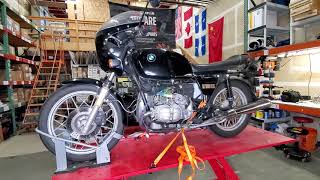


Thumbnails load from YouTube, so they need a connection the first time; everything else on this page works offline. Videos are third-party — linked, not endorsed.
| Read before you buy | What it is | Where | Notes | ||
|---|---|---|---|---|---|
| EnDuraLast 450 W installation guidelines | v7.9 | the current revision | PDF ↗ | Full illustrated procedure. Free, public, no account needed. | |
| EnDuraLast 450 W installation guidelines | v7.7 | earlier revision | PDF ↗ | The source of the output-against-rpm figures above. | |
| EnDuraLast charging kits | the whole range | EDL1 · EDL3 · EDL4 · EDL4Li | euromotoelectrics.com ↗ | Prices as of August 2026: EDL1 $349–359 · EDL3 $455 · EDL4 $549 · EDL4Li $579. Vendor data ages — check before quoting anyone. |
Three things decide which kit you need. Get them right up front and the parcel that arrives is the one that fits.
| Trap | The rule | Applies | Notes | ||
|---|---|---|---|---|---|
| The Sachse digital ignition pairs with the PM kits | EDL4 or EDL4Li | crank-mounted, replaces points, condenser and mechanical advance | check the pairing | ignition upgrade | Configurable single or dual plug, with dyno-developed advance curves. It is sold specifically for the permanent-magnet kits, so fit it alongside an EDL4 or EDL4Li rather than on a stock, EDL1 or EDL3 system. Plan the two together and they go in as one job. |
| EDL3 is chosen by stator frame | read the Bosch number | 0 120 340 004 / 005 / 008 → the 107 mm kit | EDL3 | BMW-WSM7 Model year alone can mislead on a bike that has been apart in fifty years, and the factory sheets print the same numbers — so the bike and the book agree. One look at the stator and you know. | |
| /5 starter relay | modification required | — | EDL4 on /5 | Budget for it rather than discovering it mid-install. | |
| Have a crimper on the bench | a few connectors get remade | owner report | install | Some connectors on the regulator get cut and replaced during the install. Terminals and a crimper to hand makes it a five-minute step instead of a trip to the shop. | |
| The voltage-sense wire | worth understanding before you start | black sense wire | install | There is a good ABC thread on an '83 R100CS working through it — handy reading if the system is in and the voltage is not quite what you expect. |
| Source | What it is | Where | Notes | ||
|---|---|---|---|---|---|
| EDL4 install, filmed | 450 W PMA fitted to an airhead | start to finish | YouTube ↗ | Watch it before deciding whether this is your job or your shop's. | |
| MOA — "EnDuraLast 4: any failures?" | long-term reliability reports | 2023 thread | forums.bmwmoa.org | Includes an owner several years in on a '75 R90S without trouble. Owner reports, not data — weigh accordingly. | |
| MOA — "Airhead charging system improvements" | owners comparing upgrade routes | plus install notes | forums.bmwmoa.org | Where the connector tip above comes from. | |
| ABC — '83 R100CS voltage sense | a real install going wrong | black sense wire | airheads.org | The most useful kind of thread: someone stuck, working it out in public. |
FORUMcommunityBMW MOA airhead forum threads and the Airheads Beemer Club board, as cited above. Owner experience, not measurement.
DIAGNOSECHAPTER XXVIKnown Issues & Troubleshooting
▶
Six failure patterns account for most of what ever goes wrong with an airhead: the charging system quits, the spark disappears, the idle falls apart, oil turns up where it shouldn't, the driveline complains, or the handling goes vague. None of them is mysterious. Each one has a test order that has been settled for decades — and each test ends in a number.
This chapter deliberately holds no numbers of its own. Every step points at the chapter where the figure lives, so there is only ever one place a value can be right or wrong. Work each list top to bottom: the steps are ordered so that the cheap, common and catastrophic-if-missed causes come before the expensive and rare ones.
BMW-WSM7factory manualCharging-system test sequence and electrical test values from the factory workshop manual electrical section, as transcribed in the Electrical chapter's sources.
SNOWBUMindependent authorityDiagnostic sequences — full-field test, through-the-brushes measurement trap, coil and module heat-failure patterns, spline wear staging — consistent with Robert Fleischer's airhead diagnostic articles, snowbum.com.